
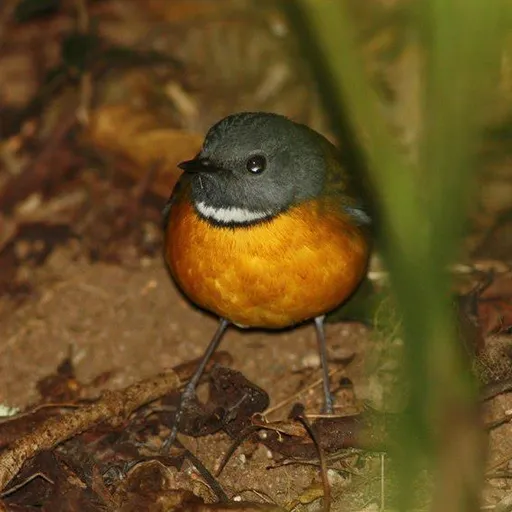
Swynnerton's Robin
Swynnertonia swynnertoni
Near Threatened
Overview
Swynnerton's robin (Swynnertonia swynnertoni) is a passerine bird in the family Muscicapidae, notable for being the sole member of its genus. The species is classified as Near Threatened on the IUCN Red List due to habitat loss and fragmentation in its localised range.
Identification
- Superficially similar to the larger White-starred robin but distinguished by a white crescent on the upper breast bordered below with a black line.
- Possesses a grey tail that lacks the yellow windows found in similar species.
- Sexually dimorphic, with females displaying duller plumage and an olive wash over the crown and face.
- Song is described as a three-note whistle rendered as "zit zitt slurr" or "tsee-tuu-tuu".
Habitat
Found in eastern and southern Africa, specifically in Tanzania, Mozambique, and Zimbabwe, where it is almost confined to montane forest between 850 and 1,850 m in altitude. It prefers dense undergrowth with a high density of saplings or rank vegetation near streams, and shows a strong association with Dracaena fragrans trees.
Diet
Largely insectivorous, feeding on beetles, wasps, bees, ants, flies, crickets, grasshoppers, spiders, and millipedes, alongside fruit and occasionally small frogs like the dwarf squeaker. During the dry season, the birds follow columns of Dorylus driver ants to catch disturbed insects.
Did you know?
The common name, genus name, and specific name all commemorate the British entomologist Charles Swynnerton, who discovered the bird before it was formally described. The nest is frequently located at the base of Dracaena fragrans leaves and is lined with dark fibres found at the bases of Cyathea tree ferns.
Sources
- Wikipedia · CC BY-SA 4.0
- Wikidata · CC0 1.0