
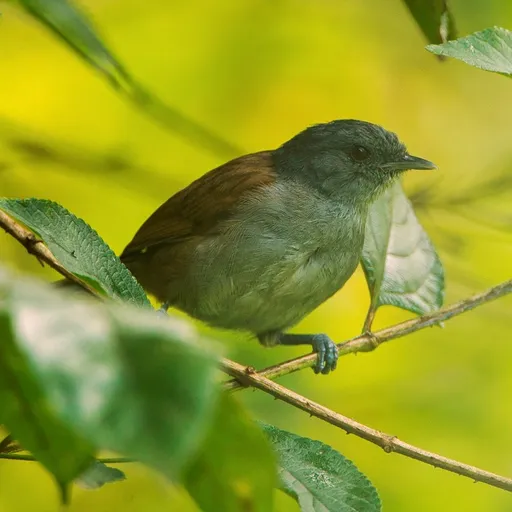
African Hill Babbler
Sylvia abyssinica
Least Concern
Listen
XC659595 · Stephen Lowe · Uluguru Mts. Above Tegetero Mission, Tanzania · CC BY-SA 4.0
Overview
The African hill babbler (Sylvia abyssinica) is a robin-like forest bird belonging to the family Sylviidae. It is classified as Least Concern on the IUCN Red List and is characterised by its arboreal habits in highland regions.
Identification
- Plumage: Bright reddish brown back contrasting with a grey head and nape; grey underparts faintly marked with white streaks and a paler belly.
- Structure: Weighs 14–25 g and measures 13–15 cm in length, featuring a thin bill with a black upper mandible and paler lower mandible, and greyish blue legs.
- Eyes: Brown eyes that may turn red, likely during the breeding season.
- Song: A rich, melodious warble resembling thrushes and orioles, composed of separated whistled phrases with frequent pitch changes, occasional scratch notes, and lower-pitched whistles.
Habitat
This species inhabits montane forest, adjacent secondary forest, and gallery forest, often favouring dense undergrowth at forest edges and clearings. Its distribution is disjointed across the highland regions of western and central Africa, ranging from southeastern Nigeria east to central Ethiopia and south to northwestern Mozambique.
Diet
The African hill babbler forages within 2 m of the ground, gleaning insects from leaves and picking fruit, though it may also feed in the canopy. It frequently joins mixed-species foraging flocks and often keeps itself concealed among creepers and vines.
Did you know?
The African hill babbler is most often detected by voice rather than sight, as it usually keeps itself concealed among creepers and vines. Its brown eyes have the unusual trait of turning red, probably when the birds are breeding.
Sources
- Wikipedia · CC BY-SA 4.0
- Wikidata · CC0 1.0