
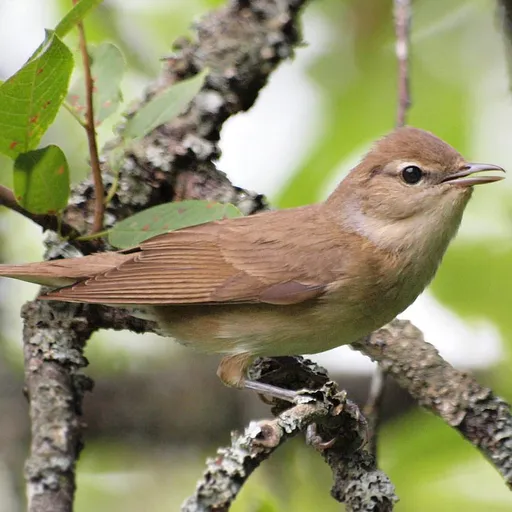
Garden Warbler
Sylvia borin
Least Concern
Listen
XC730611 · Sonothèque ADVL · Carolles, Manche, Normandie, France · CC0 1.0
Overview
The garden warbler (Sylvia borin) is a common, small passerine bird that breeds across most of Europe and the Palearctic to western Siberia. It is characterised by its plain plumage and is strongly migratory, wintering in sub-Saharan Africa. The species is classed as Least Concern by the IUCN due to its large population and wide range.
Identification
- Plumage: Plain, long-winged and long-tailed with unstreaked olive-brown upperparts and dull white underparts; the sexes are indistinguishable by external appearance.
- Features: Possesses a whitish eyering, a faint pale supercilium, a buff wash to the throat and flanks, and bluish-grey legs.
- Bill: A strong bill with a grey upper and paler grey lower mandible.
- Song: A rich, musical warbling delivered in bursts, slightly lower-pitched and more mellow than the similar song of the blackcap.
Habitat
The preferred breeding habitat in Eurasia is open woodland with dense low cover, thickets, and woodland edges, particularly near rivers or reed beds. It avoids mature conifers and closed forests, and despite its name, it rarely occupies gardens. In Africa, it uses a wide range of habitats with trees but shuns closed forests and treeless Sahel regions.
Diet
In the breeding season, the bird feeds mainly on insects and small invertebrates such as spiders, picking them off leaves and twigs. Prior to migration, it switches to a diet of fruit, particularly figs and berries, which allows for rapid weight gain. In its African wintering grounds, it maintains a mixed diet of insects and fruit, including the fruits of the Spanish flag.
Did you know?
During the crossing of the Sahara Desert, garden warblers can metabolise up to 19% of their breast and leg muscles and 39% of their digestive tract to fuel their journey. The species is also a host of the common cuckoo, a brood parasite.
Sources
- Wikipedia · CC BY-SA 4.0
- Wikidata · CC0 1.0