
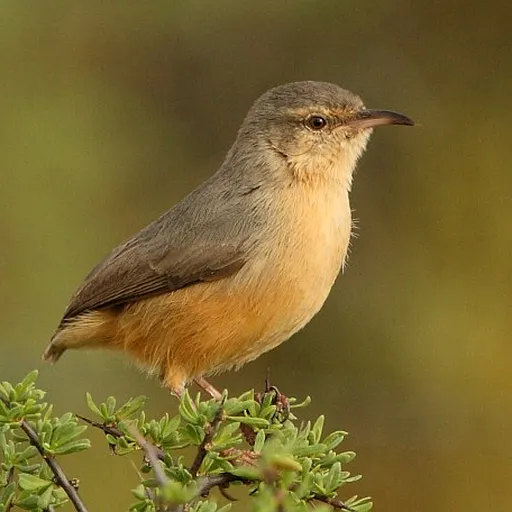
Long-billed Crombec
Sylvietta rufescens
Least Concern
Overview
The long-billed crombec, also known as the Cape crombec (Sylvietta rufescens), is a common African warbler found across southern Africa. This species is classified as Least Concern on the IUCN Red List due to its large population and extensive range.
Identification
- A small, nearly tailless bird measuring approximately 12 cm in length and weighing around 16 g.
- Upperparts are brownish grey-brown with a pale grey supercilium separated from a whitish throat by a dark eye stripe.
- Whitish breast shades into a buff belly, contrasted by a long, slightly curved blackish bill.
- Call consists of a variable series of trilled notes such as 'trreee-rriiit' and a harsh 'pttt'.
Habitat
Breeds in southern Africa from the Democratic Republic of the Congo, Zambia and Tanzania southwards to South Africa. Commonly found in fynbos, open woodland, savannah and dry Acacia scrub.
Diet
Forages methodically from the bottom to the top of bushes and trees for insects and grass seeds. It is usually seen alone, in pairs, or in family groups, but may also join mixed-species feeding flocks.
Did you know?
This monogamous, territorial species constructs a large, hanging nest made of grasses, spider webs, and plant fibres, which is attached to the lower limbs of a tree, often an Acacia.
Sources
- Wikipedia · CC BY-SA 4.0
- Wikidata · CC0 1.0