
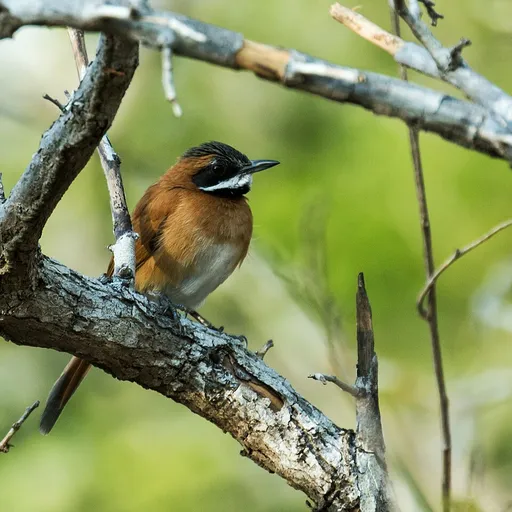
White-whiskered Spinetail
Synallaxis candei
Least Concern
Overview
The white-whiskered spinetail (Synallaxis candei) is a species of ovenbird found in northern Colombia and northwestern Venezuela. It is classified as Least Concern by the IUCN, with a stable population and no identified immediate threats.
Identification
- 15 to 17 cm in length with a dark brown iris, black maxilla, and black or blackish mandible with some yellowish on the underside.
- Nominate subspecies feature a wide white 'moustache' and a wide rufous supercilium on a blackish face, contrasting with bright rufous on the back, wings, and breast.
- Legs and feet are slate-gray to blue-gray, while the tail is bright rufous for its proximal two-thirds and dark fuscous for the distal third.
- Song consists of a repeated nasal 'a-dít-dít-du' with stronger middle notes, accompanied by a nasal 'paa-pip' call and a nasal 'naaaa' when alarmed.
Habitat
This species inhabits tropical deciduous forest, arid scrublands, overgrown pastures, and the edges of mangrove stands. It ranges in elevation from sea level to 300 m in Colombia and up to 1,100 m in Venezuela. Its distribution spans specific departments in northern Colombia and extends into northwestern Venezuela as far as Falcón and Lara states.
Diet
The white-whiskered spinetail feeds on arthropods, typically foraging in pairs. It gleans prey mostly from the ground but also from twigs and branches up to approximately 2 m above the ground.
Did you know?
Nests are constructed as a mass of thorny sticks that are roughly twice as long as they are wide or high, featuring a tunnel entrance near the top and an interior lined with leaves and sometimes snake skins.
Sources
- Wikipedia · CC BY-SA 4.0
- Wikidata · CC0 1.0