
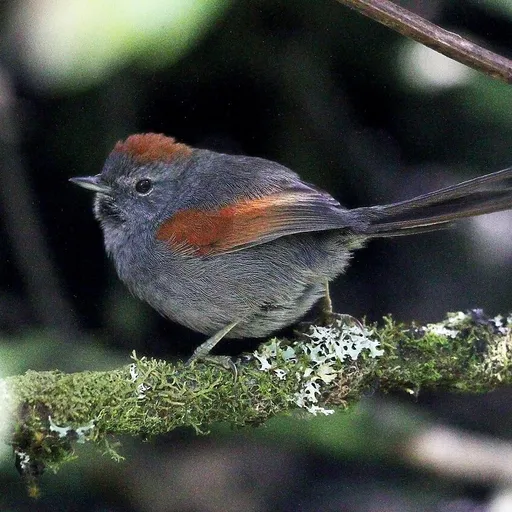
Apurimac Spinetail
Synallaxis courseni
Near Threatened
Listen
XC1157194 · Jian Mei · Huanipaca, Abancay Province, Apurimac, Peru · CC BY-SA 4.0
Overview
The Apurimac spinetail (Synallaxis courseni) is a small, near-threatened bird in the ovenbird family Furnariidae, endemic to a very limited range in south-central Peru. It is currently classified as Near Threatened by the IUCN, with an estimated population of 600 to 1,700 mature individuals.
Identification
- Size: 17 to 18 cm long, weighing approximately 15 g.
- Plumage: Dark gray face with a pale gray supercilium; dark rufous hindcrown and nape; dark gray back with an olivaceous tinge; rufous wings with dark brown flight feather tips; very long, graduated tail that is dark sooty brown with a rufous hint.
- Bill: Black or dark gray maxilla; bluish gray mandible with a black tip.
- Song: A sharp, nasal-like 'keet-kweet' often repeated for minutes, similar to that of Azara's spinetail, accompanied by a low chatter or churring trill.
Habitat
It inhabits cloudforest, humid Podocarpus forest, and regrowing vegetation in clearings or landslide scars on the slopes of Ampay mountain, southwest of the Apurimac River. The species favours dense understory and stands of Chusquea bamboo at elevations between 2,450 and 3,500 m.
Diet
The bird feeds on arthropods, gleaning prey from moss, lichen, small branches, and foliage typically in dense cover near or on the ground. It forages singly or in pairs, and occasionally joins mixed-species feeding flocks.
Did you know?
The specific epithet courseni honours C. Blair Coursen, whose interest in Neotropical birds and generous support for fieldwork resulted in the important Peruvian collections that provided the holotype for the species' first description.
Sources
- Wikipedia · CC BY-SA 4.0
- Wikidata · CC0 1.0