
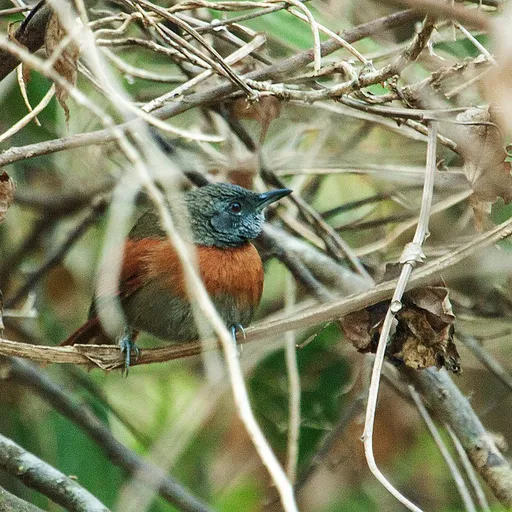
Rufous-breasted Spinetail
Synallaxis erythrothorax
Least Concern
Listen
XC737283 · Justin Watts · Petcacab, Felipe Carrillo Puerto, Quintana Roo, Mexico · CC BY-SA 4.0
Overview
The rufous-breasted spinetail (Synallaxis erythrothorax) is a species of ovenbird in the subfamily Furnariinae. It is a year-round resident bird found across parts of Central America and Mexico, assessed as Least Concern by the IUCN.
Identification
- A small bird measuring 13 to 16 cm in length, featuring a deep cinnamon rufous breast and mottled whitish or mouse-gray belly.
- Upperparts are sepia brown with chestnut wings and tail, while the chin and upper throat display slate-black coloration with white streaks.
- The species possesses a black bill, bright gray to greenish-gray legs, and dark red to reddish-brown irises.
- Vocalisations include a nasal weet!-weet!-weet!-Wur'r'r'r'r'r song and a high, rising shriek described as wirutuwit-wít-truw.
Habitat
The species inhabits landscapes characterised by dense vegetation, including the edges of lowland evergreen forests, secondary forests, second-growth scrublands, brushy clearings, and swampy areas. Its range spans from Veracruz and the Yucatán Peninsula in Mexico through Belize, Guatemala, Honduras, and El Salvador, typically ranging from sea level to 1,250 m in Guatemala and 750 m elsewhere.
Diet
It feeds mostly on arthropods but also includes small berries in its diet. The bird usually forages singly or in pairs, gleaning prey from foliage and the ground within dense vegetation.
Did you know?
Both members of the pair construct a dome-shaped nest made of thorny sticks that may be half again as long as it is high, featuring a tunnel entrance and an inner chamber of grass and fine twigs.
Sources
- Wikipedia · CC BY-SA 4.0
- Wikidata · CC0 1.0