
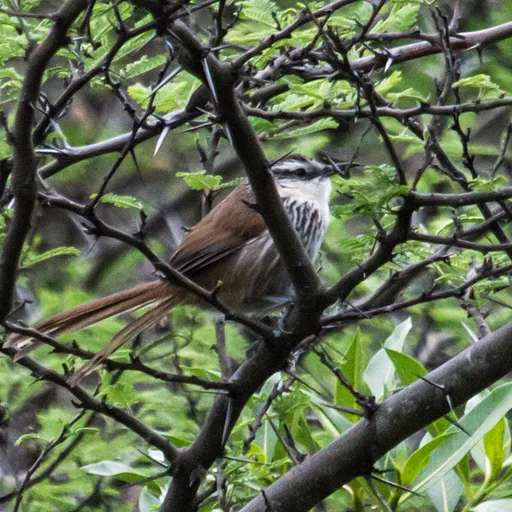
Great Spinetail
Synallaxis hypochondriaca
Near Threatened
Overview
The great spinetail (Synallaxis hypochondriaca) is a Near Threatened ovenbird endemic to northern Peru. As a member of the Furnariidae family, it represents a large, long-tailed furnariid that was formerly classified in the genus Siptornopsis before molecular studies placed it within Synallaxis.
Identification
- A large bird measuring 17 to 19 cm in length with a graduated, dusky brown tail.
- Features a wide white supercilium, dusky lores and ear coverts, and a creamy whitish malar area.
- Exhibits a dull brown crown with faint buffy streaks on the forehead, while the back is lighter brown and the wing coverts are rufous to brownish rufous.
- Vocalises with a loud, rapid spluttering accelerating and decelerating chatter of 'thk' notes interspersed with nasal 'dew' notes, often sung in duet.
Habitat
Restricted to the upper valley of the Marañón River in northern Peru, spanning parts of the Amazonas, Cajamarca, La Libertad, and Ancash departments. It inhabits arid montane landscapes characterised by dense scrub, cactus, and trees such as Acacia, Bombax, and Alnus, typically between elevations of 2,000 and 2,800 metres, though possibly reaching 3,000 metres.
Diet
The species feeds on arthropods, usually foraging singly, in pairs, or in small family groups. It gleans prey from foliage and small branches, occasionally from the ground, up to about 2 metres above the surface.
Did you know?
Its nest is constructed as a large globe of thorny sticks with a side entrance, although little else is known about its breeding biology.
Sources
- Wikipedia · CC BY-SA 4.0
- Wikidata · CC0 1.0