
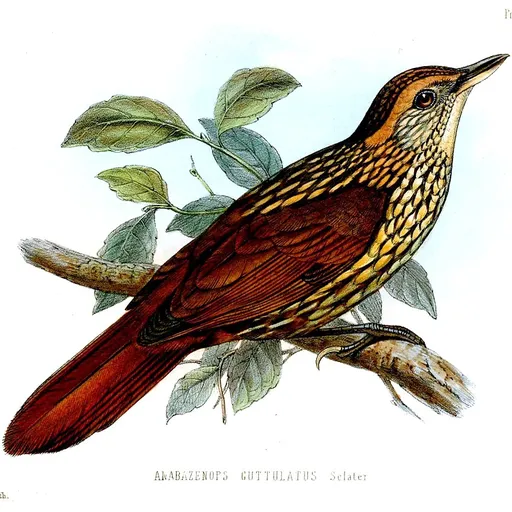
Guttulate Foliage-gleaner
Syndactyla guttulata
Least Concern
Overview
The guttulate foliage-gleaner (Syndactyla guttulata) is a species of bird in the ovenbird family Furnariidae, endemic to Venezuela. It is a year-round resident that is considered uncommon to locally fairly common and is currently assessed as being of Least Concern by the IUCN.
Identification
- Measures 17 to 19 cm in length and weighs 34 to 38 g, characterised as a largish furnariid with a more wedge-shaped bill than others in its genus.
- Adults display dark rufescent brown upperparts with black-edged rusty to whitish buff streaks, a pale-spotted dark brown face with narrow buff streaks on the ear coverts, and a yellowish throat with dark brown lower edges.
- The song consists of a harsh, accelerating sequence such as 'cjak, cjak, czak czak-zak-zak-zak-za-za-za', while the call is a harsh, rough 'chak'.
- Sexes are identical in plumage, with dark brown irises, dark gray to blackish upper bills, pale horn-gray lower bills, and olive-gray legs.
Habitat
Inhabits primary montane evergreen forest and secondary forest in Venezuela at elevations between 900 and 2,100 m. Its range is restricted to the northern coast, specifically the Sierra de San Luis and the Venezuelan Coastal Range from Falcón state east to Aragua state, with a disjunct population between Anzoátegui and Monagas states.
Diet
Feeds mostly on arthropods, foraging singly, in pairs, in mixed-species flocks, or by following army ant swarms. It typically forages in the dense undergrowth of the understory but occasionally reaches the mid-storey. Foraging techniques include gleaning from dead leaves and bromeliads, flaking bark, chiselling into twigs, and clinging sideways or upside down on branches.
Did you know?
The English name was originally rendered as 'guttulated', but this was corrected to 'guttulate' after it was noted that 'guttulated' does not exist in English; guttula is an obscure term for a drop-shaped spot, for which 'guttulate' is the correct adjectival form. Very little is known about its breeding biology aside from the observation that a potential nest was found in a twig-filled cavity within a wall.
Sources
- Wikipedia · CC BY-SA 4.0
- Wikidata · CC0 1.0