
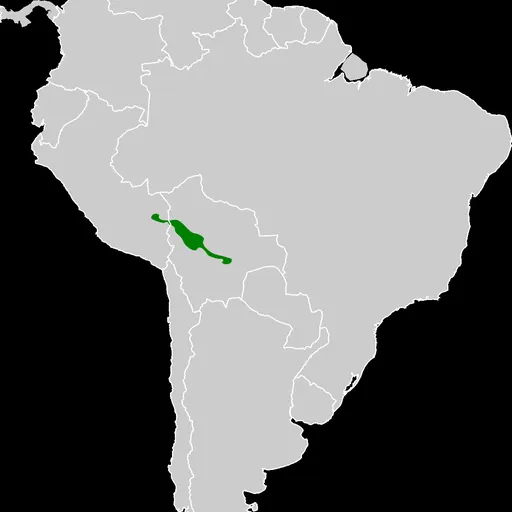
Bolivian Recurvebill
Syndactyla striata
Least Concern
Overview
The Bolivian recurvebill (Syndactyla striata) is a largish ovenbird found in Bolivia and Peru. It was formerly placed in the genus Simoxenops but was moved to Syndactyla following genetic studies that confirmed its close relationship with the Peruvian recurvebill.
Identification
- 19 to 20 cm in length with a heavy, wedge-shaped, and somewhat upturned bill.
- Mostly grizzled brownish and rufous face featuring a buff supercilium, with a dark rich reddish-brown crown and back streaked with dark buff.
- Orange-rufous throat and malar area with blurrily streaked orange-rufous and brown breast and upper belly.
- Grayish legs and feet with a gray bill and dark iris.
- Harsh, staccato, rattling ascending song that levels in pitch and ends abruptly, accompanied by raspy 'chet' and nasal 'naah' calls.
Habitat
This species inhabits humid forest in the Andean foothills and lower montane zones of southeastern Peru and western and central Bolivia at elevations between 650 and 1,700 m. Although not a bamboo obligate, it is strongly associated with areas where Guadua bamboo is common or abundant. It is a year-round resident throughout its range.
Diet
The Bolivian recurvebill feeds on arthropods, foraging mostly in dense undergrowth within the forest understory, though it occasionally feeds up to the subcanopy. It regularly joins mixed-species feeding flocks and locates prey by gleaning, pecking, and probing dead branches, debris, and epiphytes.
Did you know?
Despite being assessed as Least Concern because it is more widely distributed and commoner than previously thought, its population is believed to be decreasing due to deforestation for agriculture, human settlement, logging, and mining operations.
Sources
- Wikipedia · CC BY-SA 4.0
- Wikidata · CC0 1.0