
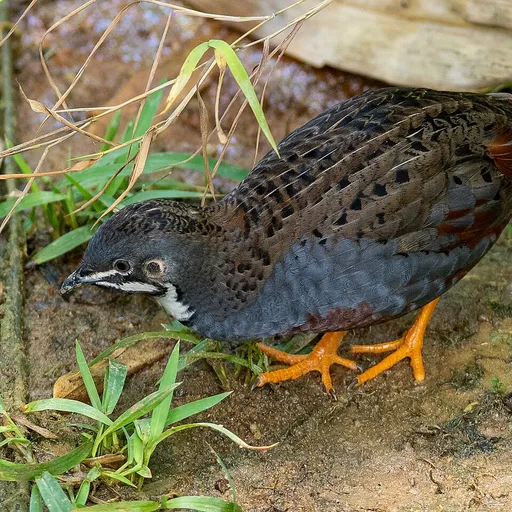
King Quail
Synoicus chinensis
Least Concern
Overview
The king quail (Synoicus chinensis), also known as the Asian blue quail, is a very small galliform and the smallest member of the family Phasianidae. It is quite common in aviculture worldwide, where it is often referred to as the button quail, despite not being closely related to true buttonquails.
Identification
- Measures 12–15 cm in length with a wingspan of about 25 cm, weighing between 20–57 g.
- Males possess a dark brown back and wings, dark blue-grey flanks and neck, and dark red-brown underparts, with a black chin bordered by a white throat band and black and white stripes below the eyes.
- Females are plainer, predominantly rufous-brown all over except for a paler belly.
- Voice includes a piping whistle described as 'ti-yu' or 'ti-ti-yu', and sharp cheeps or 'tir-tir-tir' sounds when flushed.
Habitat
King quail range in the wild from southern China, South and Southeast Asia to Oceania, extending south to southeastern Australia. They live exclusively on the ground, similar to many other game birds, and are not listed as threatened under the Australian Environment Protection and Biodiversity Conservation Act 1999, though they are considered threatened in the state of Victoria.
Diet
The diet consists of grass seeds, rape seeds, and green vegetation, supplemented by insects, particularly termites. In captivity, they are fed a variety of seeds, fruit, and vegetables, with calcium-rich sources provided during breeding to prevent egg binding.
Did you know?
Although the king quail is the smallest member of the order Galliformes, it can live up to 13 years in captivity, in stark contrast to a wild lifespan of only about 1.5 years.
Sources
- Wikipedia · CC BY-SA 4.0
- Wikidata · CC0 1.0