
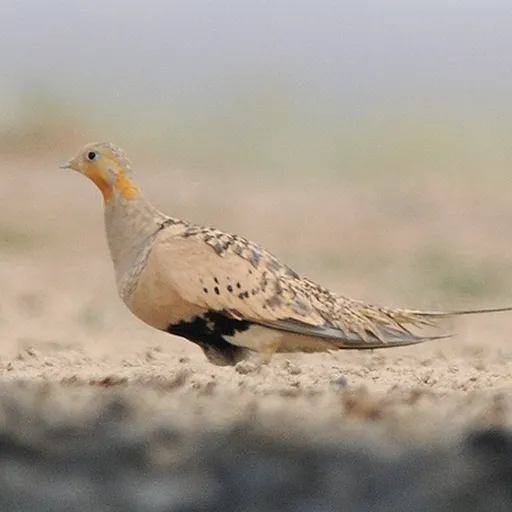
Pallas's Sandgrouse
Syrrhaptes paradoxus
Least Concern
Overview
Pallas's sandgrouse (Syrrhaptes paradoxus) is a medium to large bird in the sandgrouse family. It is named after the German zoologist Peter Simon Pallas, with its scientific name derived from Ancient Greek terms meaning 'sewn together' and 'strange'.
Identification
- Length of 30–41 cm with a small, pigeon-like head and neck, but a sturdy compact body.
- Buff-coloured plumage barred above with a black belly patch and pale underwings, distinguishing it from the Tibetan sandgrouse.
- Males have a grey head and breast, orange face, and a grey breast band, while females are duller and lack the breast band.
- Long pointed wings and tail, with feathered legs and toes that are fused together on the upper surface and lack a hind toe.
Habitat
Breeds across the middle latitudes of central Asia on dry steppes and similar habitats. It is a partial migrant, particularly from northern Kazakhstan and Mongolia, with winter movements depending on snowfall levels. Occasionally irrupts as a vagrant to parts of Europe, including Great Britain and Ireland.
Diet
Eats primarily dry seeds, which necessitates drinking large volumes of water. Large flocks fly to watering holes at dawn and dusk, making round trips of up to 121 km per day. Male parents soak their breast plumage in water to provide moisture to their chicks.
Did you know?
The sandgrouse's wings allow for fast flight with recorded speeds up to 64 km/h (40 mph). Male parents feed their chicks by absorbing water into their breast feathers and allowing the young to drink directly from the absorbed moisture.
Sources
- Wikipedia · CC BY-SA 4.0
- Wikidata · CC0 1.0