
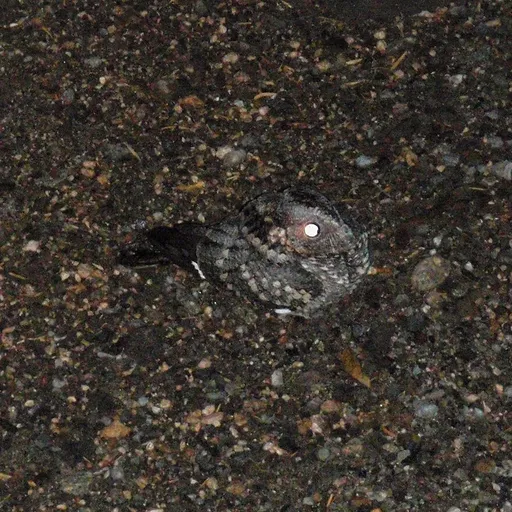
Band-winged Nightjar
Systellura longirostris
Least Concern
Listen
XC1107402 · Rosa Elena Albornoz @rosaelena_naturaleza · Los Caracas, La Guaira, Venezuela · CC0 1.0
Overview
The band-winged nightjar (Systellura longirostris) is a species of nightjar in the family Caprimulgidae and the only member of the genus Systellura. It is a widespread South American species classified as Least Concern on the IUCN Red List.
Identification
- Distinguishing feature is a white band on the wings in males and a buff band in females, most visible in flight.
- Males display white marks at the edge of the first four primaries and on the first and fourth rectrices, while females lack these tail markings.
- Size ranges from 20 to 27 cm, with a bill, legs, and feet that vary from brown to blackish-brown.
- Calls include a high-sharp territorial whistle repeated every 1 to 3 seconds and a nasal 'tchree-ee' sound when females are flushed.
Habitat
Found across South America, including the Andes, Venezuela, Chile, Argentina, Paraguay, Uruguay, and eastern Brazil, at elevations up to 4200 m. The species inhabits a wide variety of environments, from humid montane forest edges and semi-arid shrublands to urban areas, where it may roost on building rooftops.
Diet
Band-winged nightjars feed primarily on insects, including moths, beetles, and termites. In urban areas such as Rio de Janeiro, they demonstrate behavioural plasticity by roosting near artificial light sources to catch attracted insects.
Did you know?
Fledglings hatch with cryptic plumage that allows them to blend in with the surrounding ground material, remaining motionless on the first day to avoid predation.
Sources
- Wikipedia · CC BY-SA 4.0
- Wikidata · CC0 1.0