
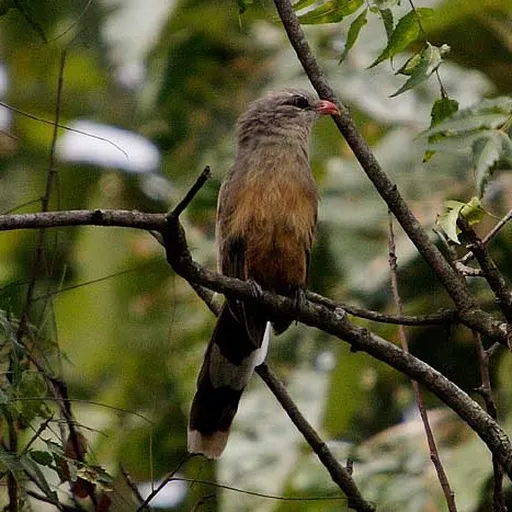
Sirkeer Malkoha
Taccocua leschenaultii
Least Concern
Overview
The sirkeer malkoha or sirkeer cuckoo (Taccocua leschenaultii) is a non-parasitic cuckoo found in the Indian subcontinent. It inhabits dry scrub forests and open woodlands and is classified as a species of Least Concern.
Identification
- Approximately 42–44 cm in length with a long, graduated tail tipped broadly in white.
- Largely dark olive brown on the upper parts with a rufous underside and a pale chin, throat and breast.
- A distinctive curved red bill with a yellow tip, which resembles that of a rose-ringed parakeet.
- Very silent in the field but may produce a low buzzing 'zwik' or sharp repeated 'kik' sounds.
Habitat
Found in dry scrub forest and open woodland habitats across the sub-Himalayan Indian subcontinent, Bangladesh and Sri Lanka, often in hilly ground but generally below 1500 m. The species is patchily distributed in Pakistan and Rajasthan, with populations expanding into the Sind region following canal irrigation.
Diet
Feeds on caterpillars, insects, other invertebrates, small vertebrates, berries and seeds. Forages singly or in pairs on or close to the ground, creeping between grasses, bushes and rocky habitats.
Did you know?
In northern India, the bird is locally known as 'junglee tota' or 'jungle parrot' due to the similarity of its distinctive bill to that of the familiar rose-ringed parakeet. When disturbed, it creeps through dense bushes and runs on the ground in a manner that makes it appear like a mongoose.
Sources
- Wikipedia · CC BY-SA 4.0
- Wikidata · CC0 1.0