
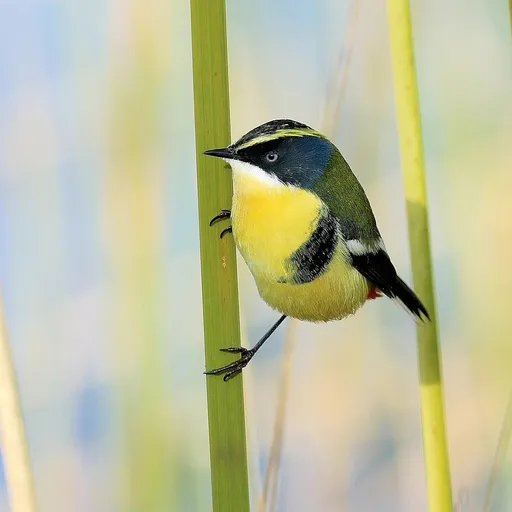
Many-colored Rush Tyrant
Tachuris rubrigastra
Least Concern
Overview
The many-colored rush tyrant, Tachuris rubrigastra, is a small passerine bird of South America that belongs to the tyrant flycatcher family Tyrannidae, though some classifications place it in its own family. It is noted as being the most colourful of all tyrannids and is currently assessed as Least Concern on the IUCN Red List.
Identification
- Length of 10.5 to 11.5 cm with a weight of 6.5 to 8 g, featuring a black crown with a slight crest and a partly hidden red patch in the middle.
- Large golden supercilium and glossy blue to black lores that extend onto the ear coverts, creating a masked appearance, with a bright moss-green back and rump.
- Wings are black with white edges that form a large bar when closed, while the tail is mostly black with white outermost feathers.
- Bright yellow breast and belly marked by a wide, nearly complete, black bar, with a crissum that is bright red to orange-red or pinkish red.
- Song described as a quiet, mellow, and pleasant series of 'noes' with a short buzz at the start and ending with a loose musical rattle.
Habitat
This species has a disjunct distribution across Argentina, Bolivia, Brazil, Chile, Paraguay, Peru, and Uruguay, ranging in elevation from sea level to 4,300 m. It almost exclusively inhabits large reedbeds in lakes and marshes, though it occasionally occurs in adjoining grassy edges.
Diet
The many-colored rush tyrant feeds on insects, foraging singly or in small family groups almost always concealed in reeds. It gleans acrobatically, sometimes hanging upside down on reeds, and also forages on mud and floating vegetation near cover.
Did you know?
The species constructs a distinctive deep cone-shaped cup nest from wet reed leaves that harden as they dry, achieving a consistency that has been likened to cardboard. Additionally, a 2013 DNA-based study revealed that it belongs to an isolated lineage that had been separated from other suboscines for around 25 million years.
Sources
- Wikipedia · CC BY-SA 4.0
- Wikidata · CC0 1.0