
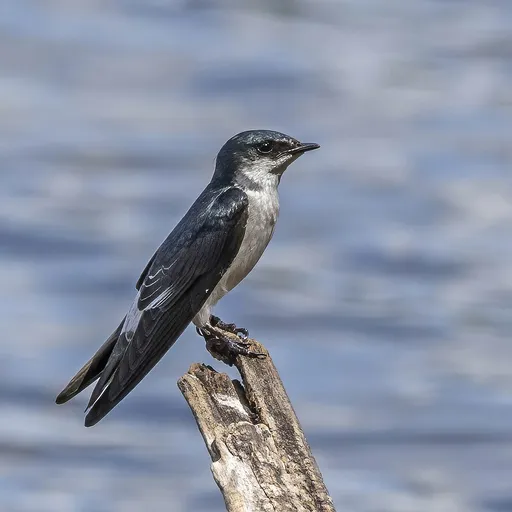
Mangrove Swallow
Tachycineta albilinea
Least Concern
Overview
The mangrove swallow (Tachycineta albilinea) is a small passerine bird in the swallow family that breeds in coastal regions from Mexico through Central America to Panama. It is classified as a species of least concern by the IUCN, with an estimated population of at least 500,000 individuals.
Identification
- Relatively small swallow, 11–12 cm long, with iridescent blue-green upperparts that appear greener when fresh and bluer when worn.
- White underparts, rump, and wing-coverts, contrasted with blackish flight feathers and a slightly forked black tail.
- Distinctive thin white line above the black lores, a feature shared only with the violet-green and white-rumped swallows.
- Song is generally described as a soft trilling, accompanied by a rolled "jeerrt" call and a sharp alarm note.
Habitat
Native to Mexico and all of Central America, including Belize, Guatemala, Honduras, El Salvador, Nicaragua, Costa Rica, and Panama. It is typically found near low-lying bodies of water, mangrove forests, and intertidal zones, with elevations usually below 600 m in Mexico and up to 1,000 m in Costa Rica. Though a full-time resident, it is rarely found in the highlands and has been recorded as a vagrant in the United States.
Diet
An aerial insectivore, it subsists primarily on small, flying insects, including unusually large prey for its size such as dragonflies and bees. It forages close over bays, lakes, and large rivers, typically in the early morning and late afternoon, and feeds alone or in pairs while breeding, but in small flocks when not breeding.
Did you know?
Despite its small size of about 14 grams, the mangrove swallow eats prey that is unusually large for a bird of its size, such as dragonflies and bees. It is also host to Sternostoma hirundinis, a type of nasal mite.
Sources
- Wikipedia · CC BY-SA 4.0
- Wikidata · CC0 1.0