
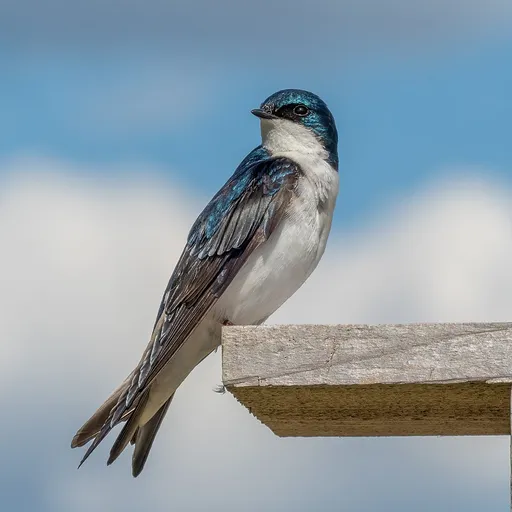
Tree Swallow
Tachycineta bicolor
Least Concern
Listen
XC1006907 · Ryan Douglas · Mount Airy, Frederick County, Maryland, United States · CC BY-SA 4.0
Overview
The tree swallow (Tachycineta bicolor) is a migratory bird of the family Hirundinidae found throughout the Americas. First described in 1807, it is currently classified as a species of least concern by the IUCN Red List due to its large range and stable population.
Identification
- Males possess glossy blue-green upperparts with blackish wings and tail, contrasting with pure white underparts and a white cheek patch.
- Females are duller, sometimes featuring a brown forehead or brown upperparts with variable blue feathers, while juveniles have brown upperparts and gray-brown-washed breasts.
- The species measures 12 to 14 cm in length with a wingspan of 30 to 35 cm, featuring a black bill, dark brown eyes, and pale brown legs.
- The song comprises a chirp, a whine that shifts in frequency, and a twice-uttered gurgle, alongside a chatter call used to advertise nest sites.
Habitat
Breeding occurs across North America, extending from north-central Alaska to the tree line in Canada and south to states like Tennessee, California, and Kansas. During winter, the species ranges from the southwestern United States along the Gulf Coast to the West Indies, Panama, and northwestern South America. It primarily inhabits open and wooded areas near water and often uses cane or reed beds over water as roosting sites.
Diet
As an aerial insectivore, the tree swallow forages both alone and in groups to consume insects, which form the bulk of its diet. It also feeds on mollusks, spiders, and fruit, with both sexes participating in feeding the nestlings.
Did you know?
Due to the extensive research conducted on it and its willingness to breed in artificial nest boxes, the tree swallow is considered a model organism by some biologists.
Sources
- Wikipedia · CC BY-SA 4.0
- Wikidata · CC0 1.0