
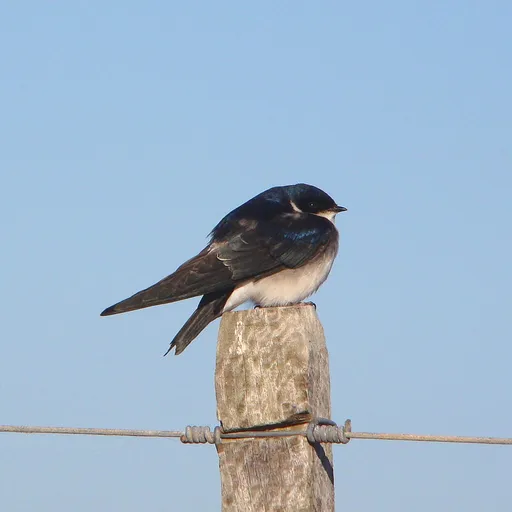
Chilean Swallow
Tachycineta leucopyga
Overview
The Chilean swallow is a species of bird in the family Hirundinidae that breeds across Chile and Patagonia, with migration extending north to Bolivia, Paraguay, and Rio Grande do Sul. This species is considered a least concern by the IUCN, with an estimated range of over two million square kilometres.
Identification
- Approximately 13 cm in length, with a weight of 15–20 g. - Glossy blue-black upperparts and black wings and tail, with white tips on the inner secondaries and tertials. - White underparts and rump, with grey underwing coverts and auxiliaries. - Black bill and legs; sexes appear alike, while juveniles are duller and browner.
Habitat
Native to Argentina, Bolivia, Brazil, Chile, the Falkland Islands, Paraguay, and Uruguay, with vagrant occurrences in South Georgia and the South Sandwich Islands. Breeding sites range from the Atacama Desert in Chile to the southern tip of South America. The species is a year-round resident in the northern part of its range, while in the southern part it is migratory, with wintering populations thought to lie in northern Argentina, southern Brazil, Uruguay, and possibly Bolivia.
Diet
These birds are insectivores, usually feeding on flying insects. They forage alone or in small groups, with low and direct flight paths.
Did you know?
After the breeding season, the Chilean swallow forms flocks.