
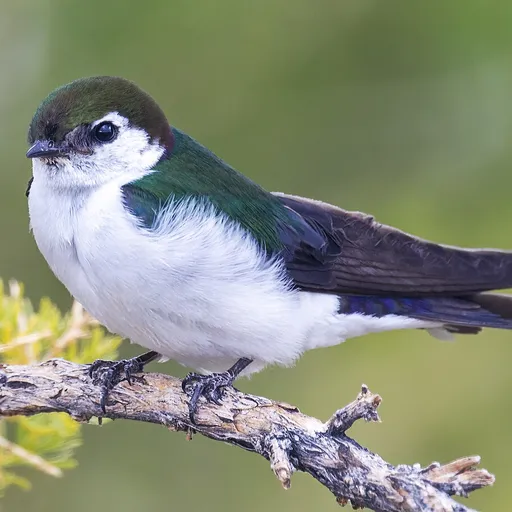
Violet-green Swallow
Tachycineta thalassina
Least Concern
Listen
XC550991 · Peter Wilton · San Jose, Santa Clara County, California, United States · CC BY-SA 4.0
Overview
The violet-green swallow (Tachycineta thalassina) is a small North American passerine bird in the swallow family. It is classified as Least Concern on the IUCN Red List.
Identification
- Glossy green on the top of the head and back, with hints of purple on the nape, rump, and upper tail.
- White rump side-patches that often appear as a continuous stripe, separating the green back from the purple tail.
- White underparts that extend onto the cheeks, partially surrounding the eye.
- Average body length of 12–13 cm, with a slightly shallower tail notch than the tree swallow.
- Vocalisations include 'chee-chee' calls used for social cohesion and parent-juvenile recognition, and 'twitter' calls associated with courtship and territorial disputes.
Habitat
Violet-green swallows are predominantly found in western North America, ranging from central Alaska down to Mexico and extending eastward into states such as Montana and Texas. They inhabit deciduous, coniferous, and mixed forests, as well as canyons and areas near large cliffs, often nesting in tree holes or cliff cracks. Breeding typically occurs at lower elevations, and the winter range is restricted to Mexico.
Diet
Specialised aerial insectivores, these birds catch and eat prey while in flight, often feeding higher in the sky than most other swallows. Their diet includes insects such as ants, beetles, and flies, as well as other arthropods like spiders. Although rare, they have been observed foraging on the ground.
Did you know?
Violet-green swallows have been observed entering a state of torpor during harsh winter conditions, resulting in a significant decrease in body temperature and metabolic rate. They also exhibit a form of interspecific cooperation where they protect and feed the fledglings of western bluebirds in shared nest boxes.
Sources
- Wikipedia · CC BY-SA 4.0
- Wikidata · CC0 1.0