
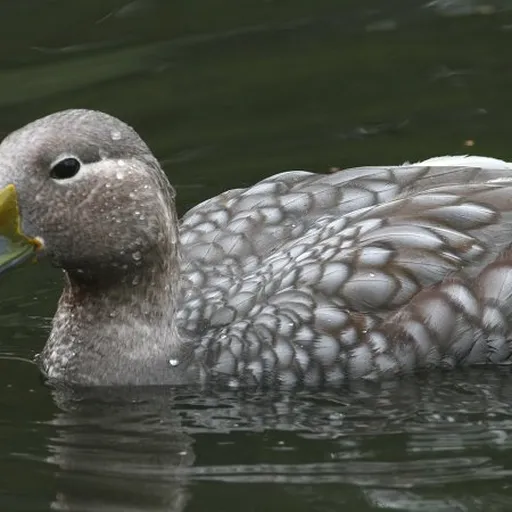
Flying Steamer Duck
Tachyeres patachonicus
Least Concern
Overview
The Tachyeres patachonicus, or flying steamer duck, is a South American waterfowl in the family Anatidae and the only member of its genus capable of sustained flight. As a Least Concern species, it is widely distributed across the Southern Hemisphere, occupying both freshwater and marine environments.
Identification
- Brown head and neck with distinct white stripes stretching from the eyes to the nape; brown-grey gradient body and white underbellies.
- Orange feet with cornified orange carpal knobs on the wings, used in combat and display.
- Orange bills with black tips in females, contrasting with darker grey bills with slight yellow accents in males.
- Vocalisations consist of grunts that differ by sex, with males producing whistle-like 'rasping', 'ticking', and 'sibilant' calls.
Habitat
Resides in aquatic areas of central and southern Chile and Argentina, as well as the Falkland Islands. Notably the only steamer duck to occur on inland fresh waters, it is also found in marine environments and is more widely distributed than its flightless relatives due to its ability to fly.
Diet
Forages primarily in pairs, favouring deep-water kelp beds or shallow water zones. Feeds on mollusks, crustaceans, and other marine invertebrates, though specific prey species are not fully documented.
Did you know?
Both sexes are notoriously pugnacious and intensely territorial, often attacking other birds without provocation, such as targeting entire flocks of silvery and hooded grebes or killing red shovelers seemingly without reason. Males attack opponents by grabbing them by the neck and striking their heads with specialised carpal wing knobs.
Sources
- Wikipedia · CC BY-SA 4.0
- Wikidata · CC0 1.0