
Ruby-crowned Tanager
Tachyphonus coronatus
Least Concern
Overview
The ruby-crowned tanager (Tachyphonus coronatus) is a small, sexually dimorphic species of tanager found primarily in southern South America. Classified as Least Concern by the IUCN, it is considered common to frequent in Brazil and inhabits a variety of open landscapes from sea level to moderate elevations.
Identification
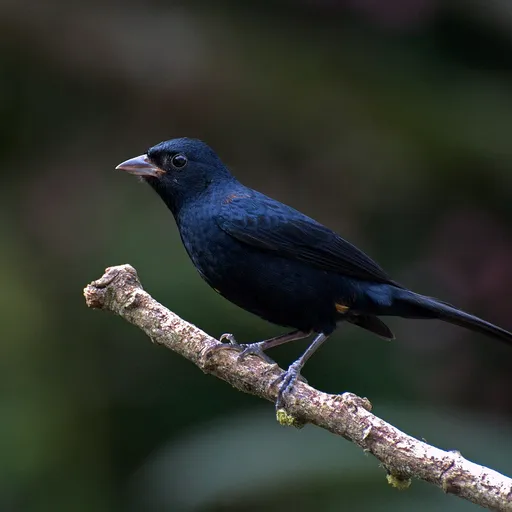
- Adult males are mostly glossy blue-black with a usually hidden red patch on the crown, while females have grayish heads, rufous-brown upperparts, and pale yellowish buff underparts with faint dusky streaks.
- Approximately 16 cm long and weighing 26 to 33 g, the bird possesses a black maxilla, a bluish gray mandible with a largely black tip, dark brown irises, and dark gray legs.
- The song is a simple, high chirping tjur wdit tjur- -, accompanied by a high, bouncing call of trit-trit trit- -.
Habitat
Found in southern Brazil, eastern Paraguay, northeastern Argentina, and occasionally as a vagrant to Uruguay, the species prefers somewhat open landscapes such as open woodland, shrubby secondary forest, orchards, and suburban gardens. Its elevation range spans from sea level to 1,300 m, though it is generally found below 1,200 m in Brazil.
Diet
Feeds on arthropods, wild and cultivated fruit, and seeds, typically foraging singly, in pairs, or in small family groups. It forages restlessly in the mid-level to higher parts of the forest interior, flicking its wings as it examines foliage for prey.
Did you know?
Although the male bears a distinctive red patch on its crown, this feature is usually hidden except during displays. The species was initially described in 1822 as Agelaius Coronatus, mistakenly classifying it as a New World blackbird.
Sources
- Wikipedia · CC BY-SA 4.0
- Wikidata · CC0 1.0