
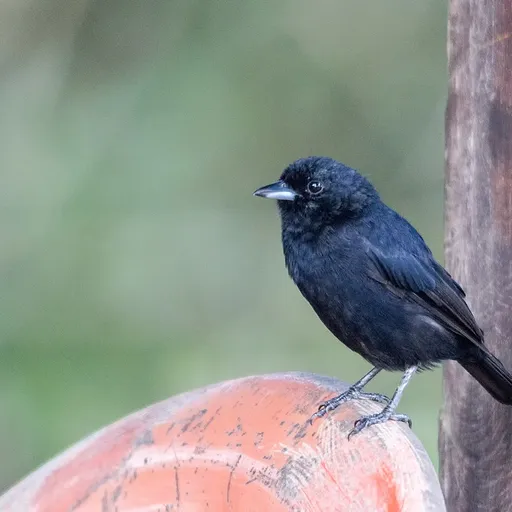
Red-shouldered Tanager
Tachyphonus phoenicius
Least Concern
Overview
The red-shouldered tanager (Tachyphonus phoenicius) is a species of bird in the family Thraupidae. It is found across parts of South America, including Bolivia, Brazil, Colombia, French Guiana, Guyana, Peru, Suriname, and Venezuela. The species is assessed as Least Concern by the IUCN Red List.
Identification
- Adult males are mostly glossy black with a small, seldom-visible red and white patch on the bend of the wing and white underwing coverts.
- Adult females possess a dark brownish gray crown that appears scalloped, with a slightly darker mask from the lores past the eye and otherwise dark grayish brown face.
- The species is approximately 15 cm long and has a black maxilla, a pale blue-gray mandible with a dark tip, and horn-gray legs.
- Song in Venezuela is described as a musical but repetitive medium-pitched 'cheurt- che’e’e’t-che’e’e’t', while calls include high, thin 'chup', 'cheup', and 'tsit' sounds.
Habitat
The red-shouldered tanager has a highly disjunct distribution with three separate populations in South America. It primarily inhabits landscapes on nutrient-poor soils such as white sands, including savanna with bushes, thickets, woodland patches, rock outcrops, and pockets of savanna in forest. Elevation ranges vary by region, from 400 m in Colombia to 2,000 m in Venezuela.
Diet
The bird feeds on small fruits and arthropods, usually foraging singly, in pairs, or in family groups, and occasionally in mixed-species feeding flocks. It feeds mostly in shrubs between 1 and 6 m of the ground, though it has been observed feeding higher in palms and woodlands in Peru.
Did you know?
In Suriname, the species builds a cup-shaped nest mostly from grass on the ground, hidden by grass or bushes, containing a clutch of one or two grayish eggs with chocolate-brown blotches.
Sources
- Wikipedia · CC BY-SA 4.0
- Wikidata · CC0 1.0