
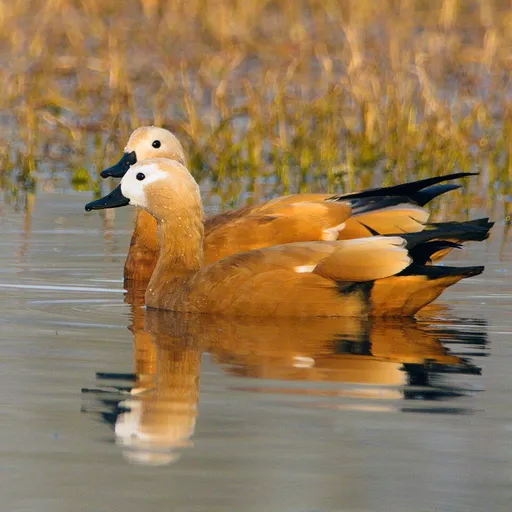
Ruddy Shelduck
Tadorna ferruginea
Least Concern
Listen
XC815483 · Sonothèque ADVL · Pontorson, Manche, Normandie, France · CC0 1.0
Overview
The ruddy shelduck (Tadorna ferruginea) is a distinctive waterfowl in the family Anatidae, characterised by its orange-brown plumage and white wing-coverts. It is a migratory species that breeds in southeastern Europe and central Asia before wintering in the Indian subcontinent, with small resident populations in North Africa.
Identification
- Length 58–70 cm with a wingspan of 110–135 cm, featuring orange-brown body plumage and a paler head.
- Black tail and flight feathers contrast sharply with white wing-coverts that are highly visible in flight.
- Males possess a narrow black collar separating the head from the body, which females lack, along with iridescent green speculum feathers on the wings.
- Produces a loud, nasal honking call that can be distinguished by sex and is made both on the ground and in the air.
Habitat
This species mostly inhabits inland water-bodies such as lakes, reservoirs, rivers, marshes and brackish lagoons. It breeds in large wetlands and rivers with mud flats and shingle banks, and is found in high-altitude lakes and swamps in central Asia and Jammu and Kashmir. The bird is seldom seen in forested areas and often frequents open locations.
Diet
The ruddy shelduck is omnivorous, feeding on grasses, young plant shoots, grain, water plants, and both aquatic and terrestrial invertebrates. On land it grazes on foliage, while in water it dabbles in the shallows or up-ends at greater depths, though it does not dive.
Did you know?
In central and eastern Asia, the ruddy shelduck is regarded as sacred by Buddhists because its plumage matches the colour of a lama's robes, providing it with some protection. Its specific name, ferruginea, is Latin for 'rusty', referring to this distinctive colouration.
Sources
- Wikipedia · CC BY-SA 4.0
- Wikidata · CC0 1.0