
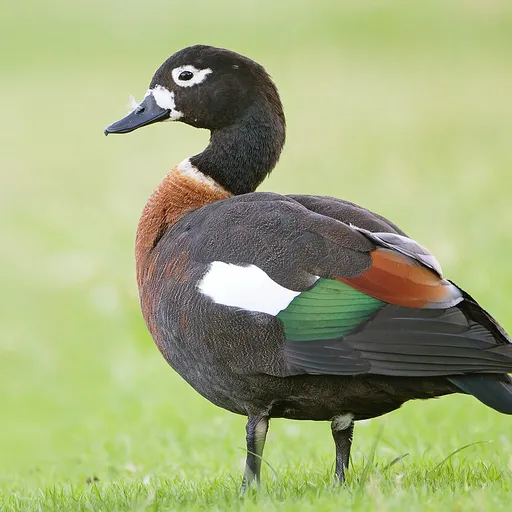
Australian Shelduck
Tadorna tadornoides
Least Concern
Overview
The Australian shelduck, also known as the chestnut-breasted shelduck or mountain duck, is a large goose-like waterfowl belonging to the family Anatidae. This species is currently classified as Least Concern on the IUCN Red List and is protected under the National Parks and Wildlife Act 1974.
Identification
- Plumage: Males feature a dark body with a striking chestnut breast, white neck collars, and dark green heads; females are similar but smaller with white around the eyes.
- Wings: Both sexes display chestnut and black wings with a green speculum, revealing white on the wings during flight.
- Size: Individuals range from 56–72 cm in length, have a wingspan of 94–132 cm, and weigh between 1.3–1.6 kg.
- Vocalisations: Males produce a deep honk similar to a goose, while females emit a high-pitched and penetrating 'zeek, zeek'.
Habitat
This species primarily inhabits lakes in fairly open country, breeding mainly in southern Australia and Tasmania. Many birds migrate north of their breeding range during winter, and they utilise specific moulting grounds such as Lake George in New South Wales where sizeable concentrations gather.
Diet
Australian shelducks feed by grazing, dabbling and filtering, consuming tubers and plant material such as saltbush and samphire. Their diet also includes a variety of insects, crustaceans and molluscs.
Did you know?
The genus name Tadorna derives from Celtic roots and translates to 'pied waterfowl'. After hatching, the flightless young often aggregate in large crèches of 20 to 40 birds, and rarely up to 100.
Sources
- Wikipedia · CC BY-SA 4.0
- Wikidata · CC0 1.0