
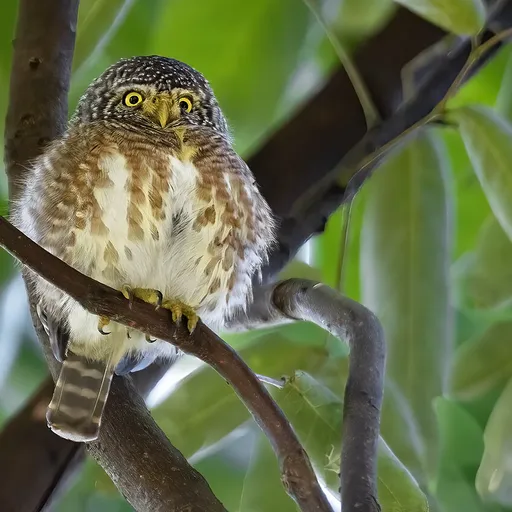
Collared Owlet
Taenioptynx brodiei
Listen
XC1080175 · Ujjal Kishor De · Ambedkar College, fatikroy, Unakoti, Tripura, India · CC BY-SA 4.0
Overview
The collared owlet, also known as the collared pygmy owl, is a species of owl in the family Strigidae and the smallest owl in Asia. It measures between 15 and 17 cm in length and weighs approximately 52 to 63 g. It is distributed throughout oriental Asia, from the Himalayas to eastern China and Taiwan.
Identification
- Measures 15–17 cm and weighs 52–63 g, making it Asia's smallest owl, with no ear-tufts.
- Features a grey-brown body with a barred back and spotted head, prominent white eyebrows, lemon-yellow eyes, and a white throat patch.
- Displays a pale collar and black spots on the nape that imitate eye spots, creating an 'occipital face' effect when viewed from behind.
- Produces a distinctive 4-note phrase 'wüp-wüwü-wüp' that starts mellow and becomes shriller, creating a ventriloquial effect that makes the bird hard to locate.
Habitat
It inhabits submontane and montane forests with open spaces, including evergreen forests, forest edges, and mixed deciduous-evergreen woodlands. Its range extends from the Himalayas in northern Pakistan to eastern China, Taiwan, and southwards through Malaysia. It typically occupies altitudes between 1,350 and 2,750 m, though it has been observed in cultivated lands as low as 700 m.
Diet
The diet consists mainly of small birds, insects, lizards, invertebrates, and small mammals. Despite its small size, it is an aggressive predator capable of capturing prey as large as itself. Prey is brought to a perch by its talons and torn up with upward pulls of the bill.
Did you know?
The collared owlet transitions through three distinct age-dependent colour morphs: a fledgling stage, an intermediate rufous (orange-red) stage, and a final grey morph. A capture-recapture study in Taiwan documented an individual changing from its rufous morph at 165 days to its grey morph by 394 days.