
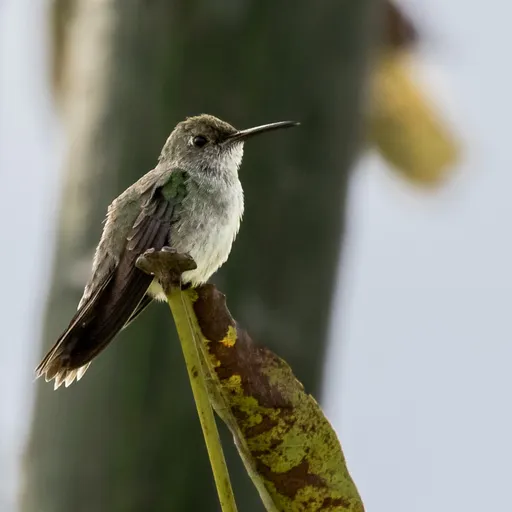
Olive-spotted Hummingbird
Talaphorus chlorocercus
Overview
The Talaphorus chlorocercus, commonly known as the olive-spotted hummingbird, is a small species of hummingbird found in South America. It is the sole member of its genus, having been transferred from Leucippus to resolve polyphyletic issues in earlier classifications.
Identification
- 12 cm long with a mass of approximately 6 g.
- Possesses a straight blackish bill.
- Displays a bronze crown and neck, with greyish-green to bronze-green upper parts.
- Throat is olive green, sometimes appearing speckled with golden green; underparts are whitish in adults and more greyish-brown in juveniles.
- Song consists of a monotonous series of multisyllabic notes, described as 'cliCHEW cliCHEW cliCHEW...', with calls including a sharp 'seek' and a wiry 'seeuee'.
Habitat
Found along the upper Amazon River and its major tributaries in northwestern Brazil, eastern Ecuador, northeastern Peru, and extreme southeastern Colombia. This species has unique habitat requirements, favouring young river islands and adjacent mainland shores where it keeps to shrubby open woodland and early successional vegetation up to 400 m in elevation.
Diet
The bird forages for nectar from flowering plants belonging to at least ten different families. In addition to nectar, it gleans insects directly from foliage.
Did you know?
The species constructs its cup nest from soft plant material and fibres bound together with spiderwebs, which is then decorated with lichen on the outside.