
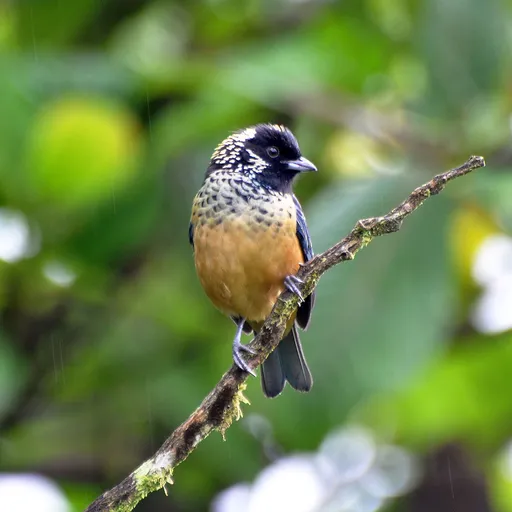
Spangle-cheeked Tanager
Tangara dowii
Least Concern
Overview
The spangle-cheeked tanager (Tangara dowii) is a medium-sized passerine bird that serves as an endemic resident breeder in the highlands of Costa Rica and western Panama. It is currently classified as a species of Least Concern.
Identification
- Measures 13 cm in length and weighs approximately 20 g, featuring a mainly black head, upperparts, and breast.
- Displays distinctive blue scaling on the breast, face sides, and neck, along with a rufous crown patch, green rump, and cinnamon belly.
- Wings and tail possess blue edgings, with adult males showing more extensive blue scaling than females.
- Immatures appear duller with no crown patch and less distinct blue scaling.
- Call consists of a high tsip.
Habitat
This species is common at altitudes between 1,200 and 3,000 m within the canopy of epiphyte-laden wet mountain forests, also utilising semi-open areas such as clearings with trees, second growth, and woodland edges at lower levels. It typically builds bulky cup nests lined with bromeliad leaves in tree forks or high amongst the epiphytes.
Diet
The spangle-cheeked tanager feeds on small fruit, usually swallowed whole, as well as insects and spiders. It is often observed foraging in pairs, family groups, or as part of mixed-species feeding flocks, particularly those containing common bush tanagers.
Did you know?
Formerly considered conspecific with the green-naped tanager, it is now understood that the two species differ geographically and genetically.
Sources
- Wikipedia · CC BY-SA 4.0
- Wikidata · CC0 1.0