
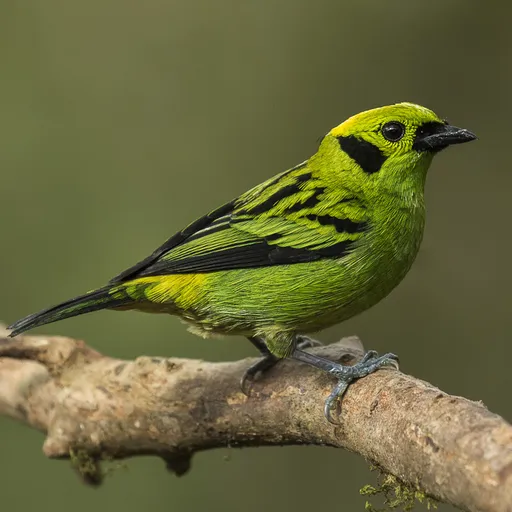
Emerald Tanager
Tangara florida
Least Concern
Listen
XC251591 · Niels Krabbe · Esmeraldas: Canandé ridge trail, Ecuador · CC BY-SA 4.0
Overview
The emerald tanager (Tangara florida) is a medium-sized bird in the tanager family Thraupidae. First described in 1869, this species is considered to be of Least Concern on the IUCN Red List despite facing threats from habitat destruction.
Identification
- Size: Medium-sized, ranging from 10.6–13 cm (4.2–5.1 in) in length and 18–20.5 g in mass.
- Plumage: Males display bright light green plumage with black streaking on the upperparts, black loral area, and auricular patches, while the crown and rump are dark yellow.
- Markings: Features black wings, a black bill, brown irises, and bluish-gray feet; females are duller with yellow-green on the head instead of yellow.
- Vocalisation: Emits a sharp chip or 'tsip' that may accelerate into a rapid twitter, and a song consisting of loud 'cheet' or 'chiip' notes.
Habitat
Found from southern Costa Rica to northern Ecuador, through Panama and Colombia, with a possible presence in extreme southern Nicaragua. The species primarily inhabits humid lowland forest, montane evergreen forest, and secondary forest between 500 and 900 m, though its range extends from 100 to 1,200 m. It is usually found in the canopy, rarely straying to the forest floor, and prefers forested habitats to semi-open ones.
Diet
This omnivorous species feeds mainly on fruit, flowers, and flower buds, while supplementing its diet with arthropods. It forages singly, in pairs, or in small flocks within mixed-species groups, gleaning fruit and capturing insects from the moss in tree crowns or from swarms of army ants.
Did you know?
The genus name Tangara is derived from the Tupí word meaning 'dancer'. The specific name florida refers to the region of Florida, even though the species has no geographical connection to that area.
Sources
- Wikipedia · CC BY-SA 4.0
- Wikidata · CC0 1.0