
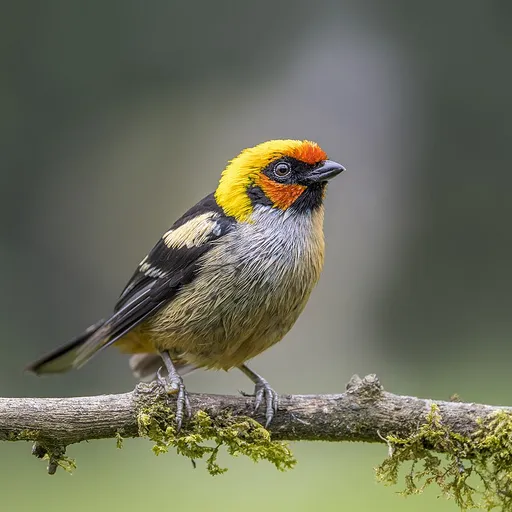
Flame-faced Tanager
Tangara parzudakii
Least Concern
Overview
The flame-faced tanager (Tangara parzudakii) is a distinctive medium-sized bird belonging to the tanager family Thraupidae. Endemic to South America, it is classified as a species of least concern by the IUCN, although its population is currently facing declines due to habitat destruction.
Identification
- Medium-sized bird measuring 14–15 cm in length with a body that is mostly black and silvery green.
- Features a striking deep red face (replaced by orangish-red in the lunigera subspecies) with a yellow crown and nape.
- Underparts are opalescent green mixed with buff, including a pale cinnamon buff central belly.
- Immatures display dull yellow on the head instead of red, with duller plumage overall.
Habitat
Found in the Andes of Colombia, Ecuador, Venezuela, and Peru, typically at elevations of 1,000–2,600 m. The species inhabits montane and cloud forests, with a preference for areas above 1,500 m, and is also present in forest edges and tall secondary growth.
Diet
This omnivorous tanager feeds on fruit, arthropods, flower buds, and nectar. Foraging occurs mainly in the canopy, with fruit gleaned or probed and arthropods collected almost exclusively from moss-covered branches.
Did you know?
The generic name Tangara is derived from the Tupí word tangara, which translates to 'dancer'. Males participate in courtship by feeding berries to females and continue to feed her during the incubation period, although they do not assist in constructing the nest.
Sources
- Wikipedia · CC BY-SA 4.0
- Wikidata · CC0 1.0