
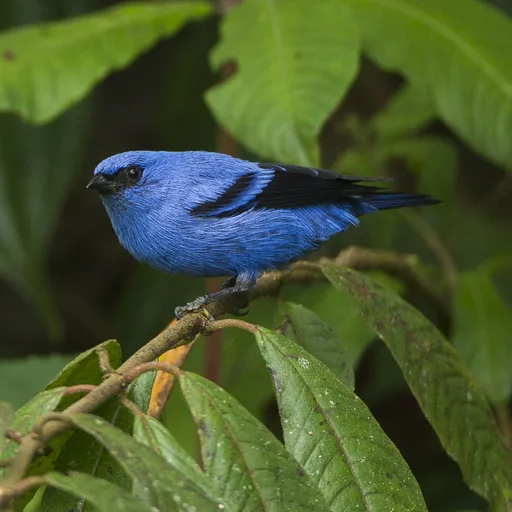
Blue-and-black Tanager
Tangara vassorii
Least Concern
Listen
XC243156 · Niels Krabbe · Cotopaxi: Costa Azul, Ecuador · CC BY-SA 4.0
Overview
The blue-and-black tanager, Tangara vassorii, is a small bird species belonging to the tanager family Thraupidae. It is the only Tangara species found near the tree line, inhabiting the highest altitudes of any member of its genus.
Identification
- Adults are approximately 13 cm long, featuring mostly cobalt blue plumage with a black mask, wings, and tail.
- Females are slightly duller than males, while subadults appear mostly grey with black wings and tails.
- The bill is notably very short and thick, black in colour, with brown irises and wine-grey feet.
- Song consists of a 2–3 second series of rhythmic, high-pitched notes that begin slowly and accelerate into a fast trill.
Habitat
Found in the northern and central Andes of Bolivia, Colombia, Ecuador, Peru, and Venezuela, this species occupies elevations between 1,500 and 3,500 m. It primarily inhabits montane evergreen forest, dwarf forest, and secondary forest, generally staying within the canopy but also using forest edges and patches of growth near the tree line.
Diet
This active forager feeds on fruit, particularly from the genus Miconia, and arthropods. It often moves through foliage to grab fruit quickly, then sits upright to eat, while arthropods are found by hopping on moss-covered branches and inspecting undersides of leaves and small bromeliads.
Did you know?
In Colombia, the blue-and-black tanager has been reported as the nuclear species, meaning it helps form and maintain the structure of large mixed-species flocks. It generally forages in groups of three to six individuals, though flocks can occasionally contain up to fifteen of these birds.
Sources
- Wikipedia · CC BY-SA 4.0
- Wikidata · CC0 1.0