
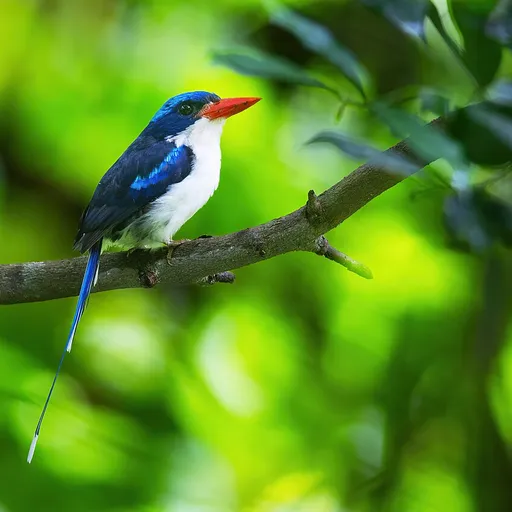
Common Paradise Kingfisher
Tanysiptera galatea
Least Concern
Overview
The common paradise kingfisher (Tanysiptera galatea), also known as the Galatea paradise kingfisher or racquet-tailed kingfisher, is a species of bird in the family Alcedinidae. It is classified as Least Concern on the IUCN Red List due to its wide range and common status, despite a slight downward population trend caused by logging.
Identification
- Plumage: Features a red bill, a dark turquoise cap with brighter blue edges, blackish cheeks, bluish-black upper parts, and white underparts with blue and white under-wing coverts.
- Tail: Central tail feathers are elongated with a blue base, described as immensely lengthened and narrowly webbed with a spoon-shaped termination.
- Similar Species: Resembles the buff-breasted paradise kingfisher (Tanysiptera sylvia) but is distinguished by the colour of the breast.
Habitat
Found in subtropical or tropical moist lowland forests of the Maluku Islands and New Guinea, typically below 500 m on the mainland and up to 820 m on Karkar Island. The distribution is patchy, with the species replaced by sister species on certain islands such as Biak, Kofiau, and Numfor.
Diet
The diet consists of invertebrates such as earthworms, grasshoppers, beetles, caterpillars, centipedes, and snails, with occasional consumption of lizards. Foraging involves perching upright on low branches to swoop down and pounce on moving prey, or plucking insects from foliage and probing leaf litter for worms.
Did you know?
The bird builds its nest by excavating a hole in the earthen wall of an active termite nest built against a tree trunk, with the entrance leading to a chamber that can be as much as 15 cm long.
Sources
- Wikipedia · CC BY-SA 4.0
- Wikidata · CC0 1.0