
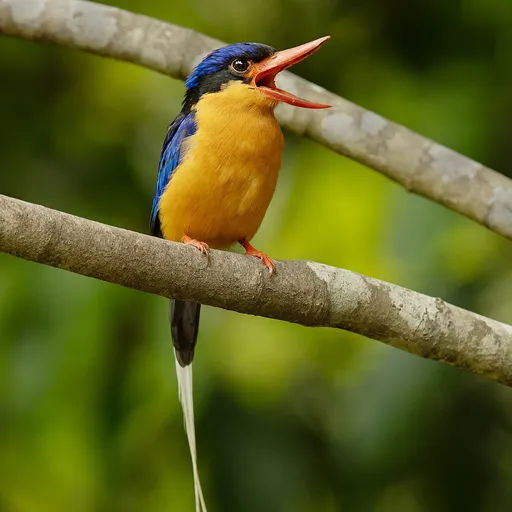
Buff-breasted Paradise Kingfisher
Tanysiptera sylvia
Least Concern
Overview
The buff-breasted paradise kingfisher, Tanysiptera sylvia, is a brightly coloured bird native to Australia and New Guinea that migrates from New Guinea to northern Queensland for the breeding season. It belongs to the tree kingfisher subfamily and is assessed as 'Least Concern' on the IUCN Red List.
Identification
- Bright plumage with rich rufous-buff underparts, a large red bill, and a blue or purple cap.
- Distinctive long tail streamers that are white or blue-and-white, varying geographically, with an identifying white patch on the centre of the upper back.
- Black eye stripes running down to the nape and red feet in adults, contrasting with the brown bill and yellowish feet of juveniles.
- Males are larger (35 cm) with longer tail feathers extending 13 cm beyond the tail, while females are smaller (30 cm) with shorter streamers.
Habitat
This species inhabits lowland monsoon rainforest and isolated patches of hill forest in areas with active termite mounds suitable for nesting. Its range covers coastal north-east Queensland and New Guinea, where it migrates north from New Guinea to breed in Australia from November to March.
Diet
The buff-breasted paradise kingfisher forages on the ground and in the middle to lower levels of the forest foliage. Its diet consists of phasmids, earthworms, beetles, insect larvae, spiders, skinks, small frogs, snails, and occasionally small tortoises.
Did you know?
Many birds perish during the 80 km flight from New Guinea to Australia, often drowning in sea spray, colliding with lighthouses, or arriving in a state of severe exhaustion. The nest chamber is noted for being very hot and strong-smelling, filled with rubbish such as pinfeather covers, faeces, and food scraps after the young have fledged.
Sources
- Wikipedia · CC BY-SA 4.0
- Wikidata · CC0 1.0