
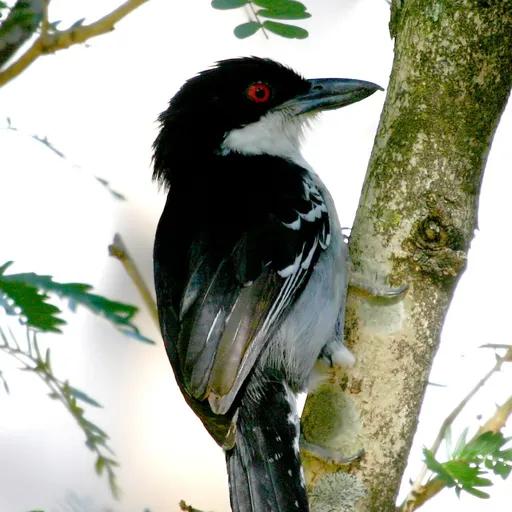
Great Antshrike
Taraba major
Least Concern
Listen
XC806720 · Rosa Elena Albornoz · Nuestra Señora del Rosario de Baruta (near Caracas), Baruta, Miranda, Venezuela · CC0 1.0
Overview
The great antshrike (Taraba major) is a large passerine bird belonging to the family Thamnophilidae, commonly known as typical antbirds. It is the sole member of its genus and is classified as a species of Least Concern, with an estimated population of at least five million mature individuals.
Identification
- A large, distinctive bird measuring 19 to 20 cm in length, featuring a heavy black bill with a hook at the end and a large crest.
- Both sexes possess a red iris, but exhibit significant sexual dimorphism: adult males of the nominate subspecies have black heads and upperparts with white spots on the wings and tail, while females display rufous crowns and reddish yellow-brown upperparts.
- The song is generally a long, accelerating series of approximately 40 notes lasting 5–14 seconds, usually ending in a snarl, though more northern and western subspecies may sing fewer notes and omit the snarl.
Habitat
Found in southern Mexico, throughout Central America except El Salvador, on Trinidad, and across mainland South America except Chile (where it is a vagrant), the species inhabits semi-humid to humid tropical landscapes such as gallery forest, savanna woodlands, and the edges of evergreen forests. It favours dense understorey vegetation and is often associated with stands of bamboo, typically occurring below 1,000 m in elevation, though it reaches higher altitudes in specific regions like Venezuela and Peru.
Diet
The great antshrike feeds on a wide variety of largish insects, arthropods, small molluscs, and small vertebrates including mammals, lizards, and minnows, alongside a small amount of vegetable matter. It forages singly or in pairs within heavy cover near the ground, hopping sluggishly from branch to branch to glean prey or dropping to the ground to seize it, and occasionally follows army ant swarms.
Did you know?
In the Brazilian Pantanal, the great antshrike has been observed feeding on aquatic prey while standing on water hyacinths. Additionally, shiny cowbirds are frequent nest parasites in Argentina, exploiting the species' cup nests suspended in branch forks.
Sources
- Wikipedia · CC BY-SA 4.0
- Wikidata · CC0 1.0