
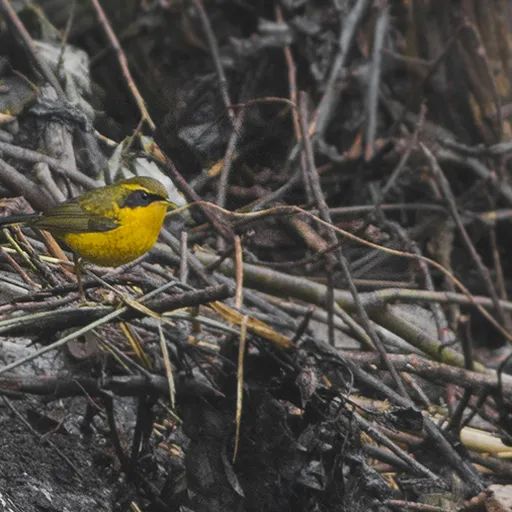
Golden Bush Robin
Tarsiger chrysaeus
Least Concern
Overview
The golden bush robin (Tarsiger chrysaeus) is a small songbird in the family Muscicapidae, first discovered in 1845 by the British naturalist Brian Houghton Hodgson. It is notable for its distinctive golden coloration and is currently classified as Least Concern on the IUCN Red List.
Identification
- Length of 14–15 cm with a weight ranging from 12 to 15 grams.
- Males feature brownish olive upperparts and bright yellow-orange underparts, while females share the same pattern but in duller tones.
- Male juveniles are dark brown with buff streaks above and below the tail, a pattern that diffuses in female juveniles.
Habitat
This species inhabits the Himalayan mountain range and surrounding highlands across Bhutan, China, India, Myanmar, Nepal, Pakistan, Tibet, and Thailand. It favours open areas within temperate and bamboo forests, grasslands, and shrubland, and has been observed exploiting human disturbance in the mountains of southern China.
Diet
Golden bush robins are insectivorous and primarily hunt for insects found close to the ground.
Did you know?
The lifespan of a golden bush robin is approximately 3.8 years.
Sources
- Wikipedia · CC BY-SA 4.0
- Wikidata · CC0 1.0