
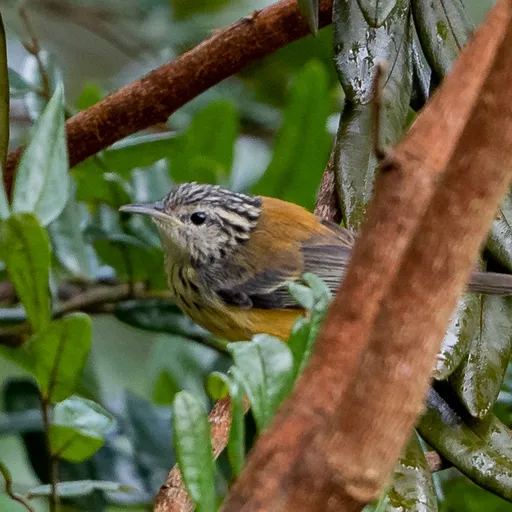
Orange-bellied Antwren
Terenura sicki
Critically Endangered
Overview
The orange-bellied antwren (Terenura sicki), also known as Sick's antwren, is a small passerine bird belonging to the family Thamnophilidae. It is classified as Critically Endangered and is endemic to the northeastern Brazilian states of Pernambuco and Alagoas.
Identification
- Small bird measuring 9.5 to 10.5 cm in length and weighing between 6.5 and 7 g.
- Adult males feature black and white streaked upperparts with white underparts, whereas females have rufous upperparts and orange underparts.
- The song is described as a "very high, very sharp 'tewée-tuwée-tititititi', diminishing in strength", accompanied by sharp 'chip' calls.
- Wings are black with pale edges on the flight feathers and wide white tips on the coverts.
Habitat
This species inhabits the subcanopy and canopy of semi-humid evergreen forest. Its distribution is disjunct across the northeastern Brazilian states of Pernambuco and Alagoas, typically occurring at elevations between 200 and 700 m, though it can be found as low as 100 m.
Diet
The diet consists mostly of insects and probably includes spiders. The bird forages singly, in pairs, or in family groups, often joining mixed-species feeding flocks, by actively and restlessly gleaning prey in dense vegetation and vine tangles at heights of 7 to 20 m above the ground.
Did you know?
The bird's IUCN Red List status has progressively worsened since 1988, moving from Threatened to Vulnerable, then Endangered, and currently Critically Endangered. Its population is estimated at only 50 to 250 mature individuals and is believed to be decreasing due to habitat destruction.
Sources
- Wikipedia · CC BY-SA 4.0
- Wikidata · CC0 1.0