
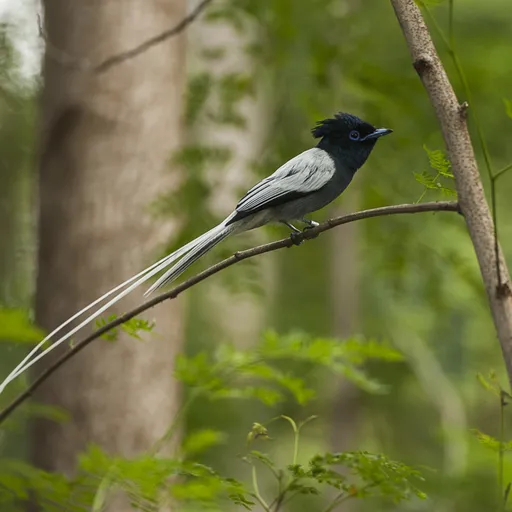
African Paradise Flycatcher
Terpsiphone viridis
Least Concern
Overview
The African paradise flycatcher (Terpsiphone viridis) is a medium-sized passerine bird found across Africa south of the Sahara and on the Arabian Peninsula. It is a locally common resident breeder that is currently classified as being of least concern by the International Union for Conservation of Nature.
Identification
- Males are approximately 17 cm long, though the central tail streamers can exceed twice the body length, while females have moderate-length tails without streamers.
- The male features a glossy black head with greenish highlights, grey to blue-grey underparts, and chestnut or rusty wings and tail, accented by a prominent white wingbar.
- Females resemble males but possess browner underparts, lack the white wingbar, and have a paler head.
- A wattle ring surrounds the eye, and the beak and other bare areas match the colour of the surrounding feathers.
Habitat
This species generally inhabits open forest and savanna environments, including savannah woodland, open grassland with isolated trees, plantations, open woodland, and scrubland. Its range covers most of Africa south of the Sahara Desert as well as the southern Arabian Peninsula.
Diet
The African paradise flycatcher is primarily insectivorous, frequently catching flies on the wing and consuming eggs, larvae, and adult insects. It also includes spiders in its diet and occasionally eats berries.
Did you know?
This species was the original bird referred to as ọ̀kín in the Yorùbá language, a term that is now applied to the peacock.
Sources
- Wikipedia · CC BY-SA 4.0
- Wikidata · CC0 1.0