
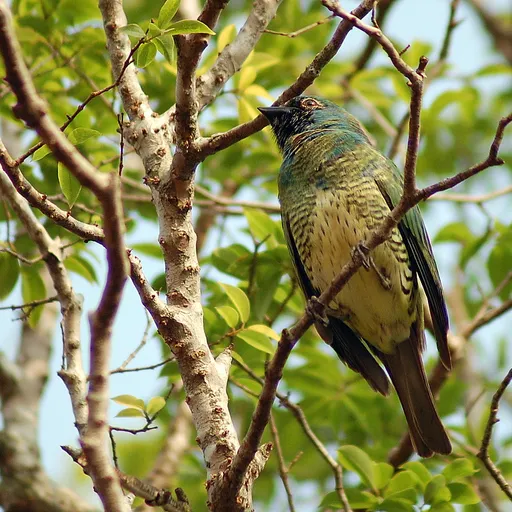
Swallow Tanager
Tersina viridis
Least Concern
Overview
The swallow tanager (Tersina viridis) is a Neotropic bird belonging to the family Thraupidae. It is the sole member of the genus Tersina and is classified as Least Concern by the IUCN.
Identification
- Size and build: Measures 14–15 cm in length and weighs 26–35 g, featuring a broad, flat black bill, a short tail, and dusky horn-gray legs.
- Plumage: Strongly sexually dimorphic; adult males are predominantly bright turquoise-blue with a triangular black mask, white belly, and barred flanks, while females are bright grass-green with a dingy gray mask, pale yellow belly, and barred flanks.
- Vocalisation: Males produce a rapid series of approximately 10–15 shrill or squeaky notes, while general calls consist of high, slightly blurred or buzzy metallic sounds.
Habitat
Found throughout South America and Panama, the species inhabits a variety of open dry to humid landscapes, including forest edges, mature secondary woodlands, shade coffee plantations, and gallery forests. It occurs at elevations reaching up to 2,900 m in the Venezuelan Andes, though it is generally found lower in other regions.
Diet
Feeds primarily on fruits and arthropods, often perching conspicuously in treetops to pluck fruit or capture insects in mid-air. It is notably gregarious, forming small flocks during the breeding season and much larger groups outside it, though it seldom joins mixed-species feeding flocks.
Did you know?
Initially described in 1811 with the binomial Hirundo viridis, the bird was mistakenly classified as a swallow due to its broad bill and flight pattern. The genus name Tersina derives from an unidentified bird described by Comte de Buffon.
Sources
- Wikipedia · CC BY-SA 4.0
- Wikidata · CC0 1.0