
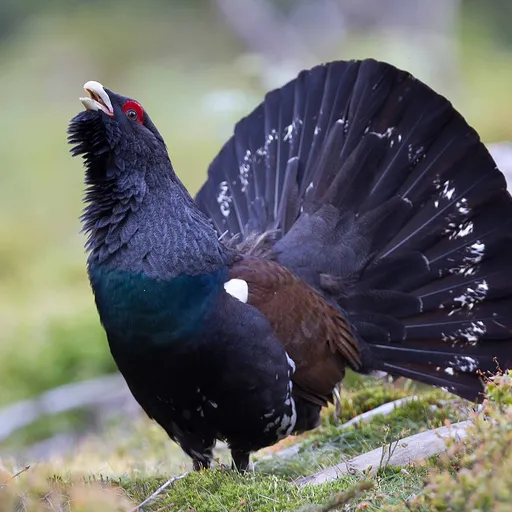
Western Capercaillie
Tetrao urogallus
Least Concern
Overview
The western capercaillie (Tetrao urogallus) is a heavy forest grouse and the largest of all extant grouse species, found across Europe and the Palearctic. It is a primarily ground-dwelling bird renowned for its pronounced sexual dimorphism and courtship displays, with males being nearly twice the size of females.
Identification
- Cocks range from 74 to 85 cm in length, averaging 4.1 kg, while hens are roughly half the size at 54–64 cm and 1.8 kg.
- Males possess dark grey to brown body feathers with dark metallic green breasts and a bright red spot of naked skin above each eye.
- Hens display brown upper parts with black and silver barring and lighter buffish yellow underparts.
- Both sexes feature a white spot on the wing bow and feathered legs equipped with elongated horn tacks that aid in snow.
Habitat
This non-migratory species inhabits mature conifer forests with diverse species composition and a relatively open canopy structure, extending across northern Europe and the Palearctic taiga. Populations are particularly concentrated in the cold temperate latitudes and the coniferous forest belt of mountain ranges in warm temperate Europe, though they avoid young and dense forests that lack sufficient cover and flight space.
Diet
A highly specialized herbivore, the western capercaillie feeds almost exclusively on blueberry leaves and berries during the growing season, supplemented by grass seeds and fresh sedge shoots. In winter, it spends most of its time in trees consuming conifer needles and buds from beech and rowan, actively ingesting small stones to aid digestion in its muscular gizzard.
Did you know?
To digest the coarse conifer needles and buds consumed during winter, the bird ingests small stones known as gastroliths that function like a mill in its gizzard to break the material into small particles.
Sources
- Wikipedia · CC BY-SA 4.0
- Wikidata · CC0 1.0