
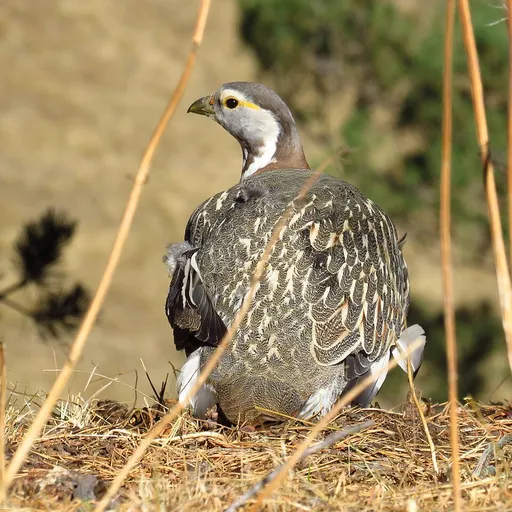
Caucasian Snowcock
Tetraogallus caucasicus
Least Concern
Overview
The Caucasian snowcock (Tetraogallus caucasicus) is a gallinaceous bird in the pheasant family Phasianidae. It is native to the Caucasus region, where it inhabits high-altitude mountain environments. The species is currently listed as Least Concern on the IUCN Red List.
Identification
- 50–60 cm long bird that appears grey from a distance, though plumage is patterned with grey, brown, white, and black.
- Distinctive white throat and white patch on the side of the neck, with a rust-colored nape.
- In flight, displays white flight feathers and undertail with reddish tail sides.
- Emits a desolate whistling song similar to a Eurasian curlew, described as 'sooo-looo-leeee'.
Habitat
Native to the Caucasus Mountains, particularly the Western Caucasus, where it breeds at altitudes between 2000 and 4000 m. The species restricts itself to bare stony mountains due to poor flight ability, which prevents travel to distant habitats. During winter, it moves down the mountain to warmer climates.
Diet
The diet consists primarily of seeds, vegetable matter, and small shrubs. Invertebrates are rarely, if ever, consumed. The bird forages by coasting down mountain sides in the early morning and returning to high-altitude resting sites by night.
Did you know?
Due to its poor flight ability, the bird is often only able to glide or drift down hills, relying on its legs to bounce between rocky slopes. This limitation restricts its movement and keeps it confined to its specific mountainous range.
Sources
- Wikipedia · CC BY-SA 4.0
- Wikidata · CC0 1.0