
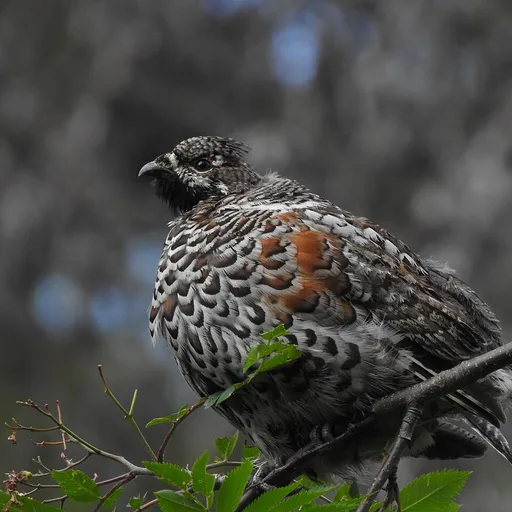
Hazel Grouse
Tetrastes bonasia
Least Concern
Listen
XC975195 · Antti Leukkunen · Kangasniemi, Etelä-Savo, Finland · CC BY-SA 4.0
Overview
The hazel grouse (Tetrastes bonasia), also known as the hazel hen, is one of the smaller members of the grouse tribe. It is a sedentary species that is classified as Least Concern on the IUCN Red List.
Identification
- A relatively small, plump bird measuring 35–39 cm in length with finely patterned plumage.
- Features grey upperparts, brown wings, and chestnut flecked white underparts.
- Males possess a short erectile crest and a white-bordered black throat, while females have a shorter crest and lack the black throat coloration.
- Males emit a high-pitched ti-ti-ti-ti-ti call and females a liquid tettettettettet, often heard rather than seen due to the bird's shyness.
Habitat
The species breeds across the Palearctic, ranging from central Europe to Hokkaido in Japan, and thrives in dense, damp, mixed coniferous woodland, preferably with some spruce.
Diet
This bird forages on the ground, feeding mainly on plant material which is supplemented by insects during the breeding season.
Did you know?
Early 20th-century English-speaking travellers to Russia referred to the bird as "rabchick", a term derived from the Russian word ryabchik.
Sources
- Wikipedia · CC BY-SA 4.0
- Wikidata · CC0 1.0