
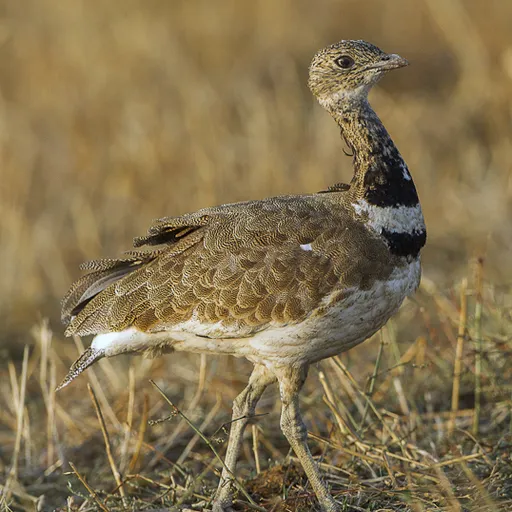
Little Bustard
Tetrax tetrax
Near Threatened
Listen
XC1134326 · Philippe_Grange · Arrondissement de Narbonne (near Ouveillan), Aude, Occitanie, France · CC0 1.0
Overview
The little bustard (Tetrax tetrax) is the smallest Palearctic bustard and the sole member of the genus Tetrax. It is currently classified as Near Threatened due to population declines caused by habitat loss across its range.
Identification
- Pheasant-sized (42–45 cm) with a 90–110 cm wingspan; flight shows extensive white on long wings.
- Breeding males have brown upperparts, white underparts, a grey head, and a black neck bordered by white bands.
- Females and non-breeding males lack the neck pattern, with females being darker below than males.
- Males produce a distinctive "raspberry-blowing" call described as "prrt", while both sexes are otherwise usually silent.
Habitat
Breeds in Southern Europe and Western and Central Asia, occupying open grasslands and undisturbed cultivation with tall plants for cover. Southern European populations are mainly resident, whereas others migrate further south in winter.
Diet
Omnivorous, consuming seeds, insects, rodents, and reptiles.
Did you know?
Despite breeding in France, the species is only a very rare vagrant to Great Britain, with its status in Cyprus being particularly noteworthy after a bird was poached in 2013, ending an official absence since 1979.
Sources
- Wikipedia · CC BY-SA 4.0
- Wikidata · CC0 1.0