
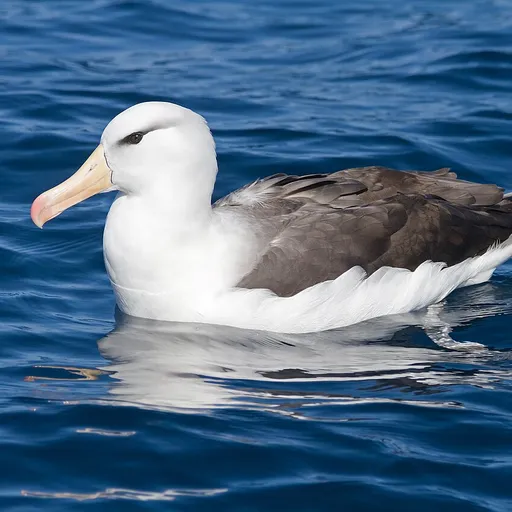
Black-browed Albatross
Thalassarche melanophris
Least Concern
Listen
Overview
The black-browed albatross (Thalassarche melanophris), also known as the black-browed mollymawk, is a large seabird and the most widespread and common member of the albatross family. It is classified as Least Concern by the IUCN Red List, although it was previously considered endangered due to population declines caused by fisheries.
Identification
- Medium-sized albatross, 80–95 cm long with a 200–240 cm wingspan and a weight of 2.9–4.7 kg.
- Dark grey saddle and upperwings contrasting with a white rump and underparts; underwings are white with broad, irregular black margins.
- Distinctive dark eyestripe and a yellow-orange bill with a darker reddish-orange tip.
- Colonies are noisy, with birds braying to mark territory and cackling harshly.
Habitat
This species is circumpolar in the southern oceans, breeding on 12 islands across the Atlantic, Pacific, and Indian Oceans. It prefers to forage over shelf and shelf-break areas, though it has a northerly migratory tendency and is the most likely albatross to be found in the North Atlantic.
Diet
The black-browed albatross feeds on fish, squid, crustaceans, carrion, and fishery discards. It has also been observed stealing food from other species.
Did you know?
A bird named Albert, believed to be the same individual since 1967, has been repeatedly sighted in Scottish and English gannet colonies, having been blown off course into the North Atlantic. A similar long-term vagrancy in the Faroe Islands gave rise to the Faroese term 'sulukongur' for an albatross living among gannets.
Sources
- Wikipedia · CC BY-SA 4.0
- Wikidata · CC0 1.0