
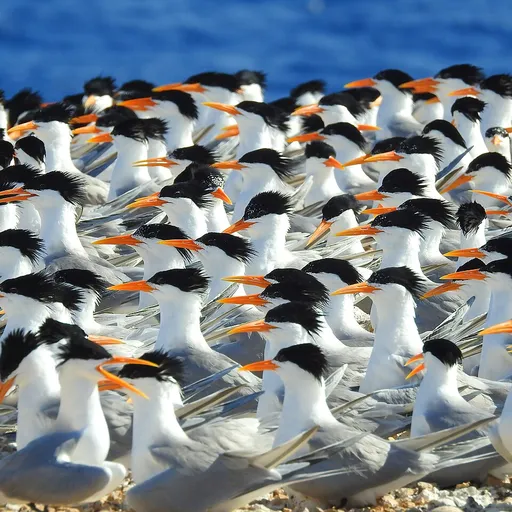
Lesser Crested Tern
Thalasseus bengalensis
Least Concern
Overview
The lesser crested tern (Thalasseus bengalensis) is a medium-large tern in the family Laridae, classified as Least Concern on the IUCN Red List. It is one of the species protected under the Agreement on the Conservation of African-Eurasian Migratory Waterbirds and the Mediterranean marine birds Action Plan.
Identification
- A medium-large tern measuring 35–43 cm in length with an 88–105 cm wingspan and a weight of 185–242 g. Summer adults possess a black cap, black legs, and a long, sharp orange bill, contrasting with grey upperwings, rump, and central tail feathers against white underparts.
- Distinguished in flight by its grey rump, a key feature separating it from related species; in winter, the forehead turns white.
- Produces a loud, grating call similar to that of the Sandwich tern.
Habitat
Breeds in subtropical coastal regions ranging from the Red Sea across the Indian Ocean to the western Pacific and Australia, with a significant population on islands off the Libyan coast in the Mediterranean. While Australian populations are likely sedentary, other groups are migratory and winter as far south as South Africa.
Diet
Feeds by plunge-diving for fish, usually from saline environments, often diving directly rather than using the 'stepped-hover' technique. Males participate in courtship displays by offering fish to females.
Did you know?
In T. b. emigratus, the species exhibits adaptive nesting behaviour by reproducing in late summer after predatory yellow-legged gulls have finished breeding and departed the area. It is also an occasional vagrant to Europe, where it has been known to breed in pairs consisting of both pure individuals and mixed pairs with Sandwich terns.
Sources
- Wikipedia · CC BY-SA 4.0
- Wikidata · CC0 1.0