
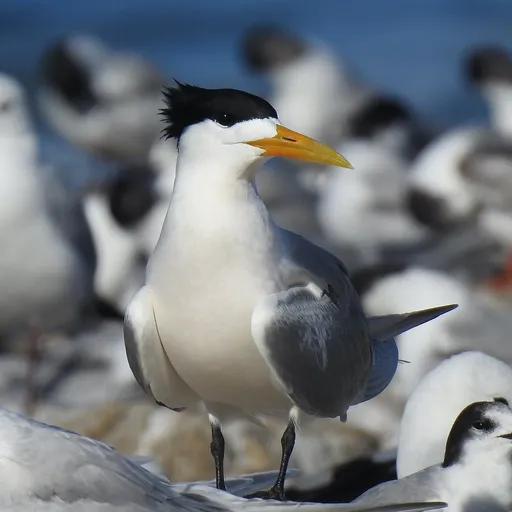
Greater Crested Tern
Thalasseus bergii
Least Concern
Listen
XC676928 · Manoj Karingamadathil · Mappila Bay, India · CC BY-SA 4.0
Overview
The greater crested tern (Thalasseus bergii) is a large tern in the family Laridae that nests in dense colonies along coastlines and islands across the tropical and subtropical Old World. It is one of the largest terns, distinguished by its dark grey upperparts, white forehead, and distinctive black crest.
Identification
- Size: Large tern, measuring 46–49 cm in length with a wingspan of 125–130 cm.
- Plumage: Darker, battleship-grey upperparts and white underparts; a white forehead persists even in full breeding plumage.
- Head: Features a glossy, shaggy black crest that recedes in winter, merging with a peppered black mask.
- Bill and Legs: Long yellow bill with a greenish tint (not orange or black) and black legs.
- Vocalisation: Highly vocal at breeding grounds, emitting a loud, raucous, crow-like 'kerrak'.
Habitat
Found in tropical and warm temperate coastal regions from South Africa around the Indian Ocean to the Pacific and Australia. It nests on low-lying sandy, rocky, or coral islands, sometimes among stunted shrubs, and has adapted to use artificial sites such as building roofs and islands in salt pans. Non-breeding individuals roost on open shores, boats, and harbour structures.
Diet
Feeds primarily on fish, which constitute nearly 90% of its diet, supplemented by cephalopods, crustaceans, and insects. It forages by plunge-diving up to 1 m deep or dipping from the surface, often swallowing prey in mid-air. The species actively follows fishing vessels to scavenge for jettisoned bycatch, particularly during prawn trawling seasons.
Did you know?
This species has demonstrated remarkable adaptability by breeding on the roofs of buildings, artificial islands in salt pans, and even sewage works. In South Africa, a significant portion of the local population was observed nesting on rooftops by the year 2000.
Sources
- Wikipedia · CC BY-SA 4.0
- Wikidata · CC0 1.0