
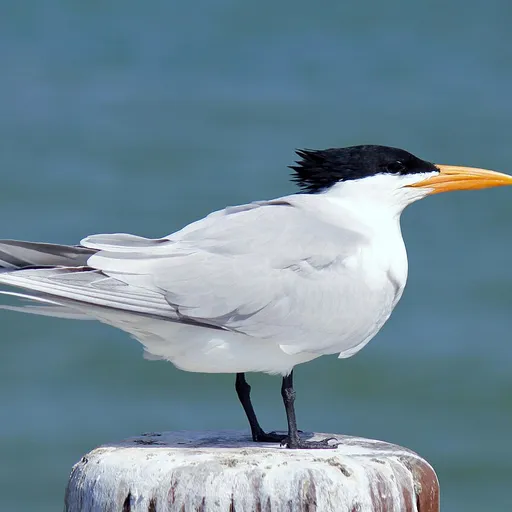
Royal Tern
Thalasseus maximus
Least Concern
Overview
The royal tern (Thalasseus maximus) is a large seabird belonging to the family Laridae, endemic to the Americas. It is the second-largest tern species in the region, surpassed only in size by the Caspian tern, and is listed as a species of Least Concern on the IUCN Red List.
Identification
- A large tern with pale silvery-gray upperparts, white underparts, and black legs.
- Features a stout, orange-red bill and a black crown with a shaggy, erectable crest on the nape during the breeding season.
- In non-breeding plumage, the forehead and upper crown become white while the nape remains black.
- Calls include short, clear shrills and a longer, rolling, plover-like whistle.
Habitat
Found on both coasts of the Americas, ranging from Texas to Virginia in the northeast and from California to Mexico on the west coast. It breeds on island or isolated beaches with limited predators, particularly in estuaries, mangroves, and lagoons, and winters along the Atlantic and Pacific coasts as far south as Peru and Argentina.
Diet
Primarily feeds on small fish such as anchovies, weakfish, and croakers, though it also consumes insects, shrimp, crabs, and hatchling sea turtles. It forages by plunge-diving into salt water from heights of nearly 9 meters, typically in small groups or alone, though it may join large groups when hunting schools of fish.
Did you know?
To catch small crabs or flying fish, the royal tern abandons its typical plunge-dive technique in favour of short, shallow dives that conceal its approach from the prey. It also feeds in fresh water on very rare occasions, despite its preference for salt water.
Sources
- Wikipedia · CC BY-SA 4.0
- Wikidata · CC0 1.0