
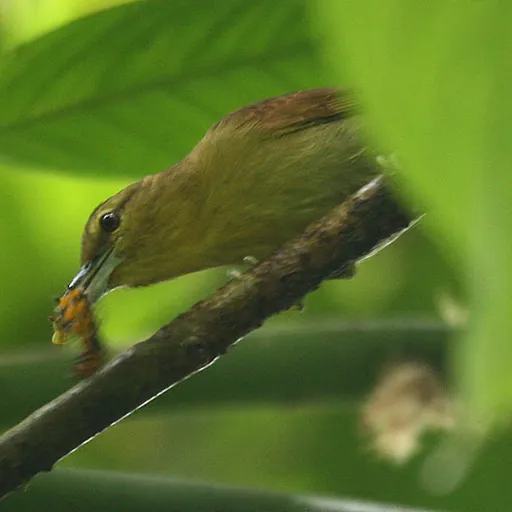
Russet Antshrike
Thamnistes anabatinus
Least Concern
Listen
XC248195 · Niels Krabbe · Esmeraldas: 18.5 road km NNW Alto Tambo, Ecuador · CC BY-SA 4.0
Overview
The russet antshrike (Thamnistes anabatinus) is a passerine bird in the subfamily Myrmornithinae of the family Thamnophilidae, commonly known as the typical antbirds. It is distributed across Mexico, Central America, and parts of northern South America.
Identification
- Small passerine bird measuring 13 to 15 cm in length with a stocky body and a heavy bill featuring a hooked tip.
- Plumage varies by subspecies, but adults typically display an olive-brown crown and upperparts, a rufous tail, and cinnamon-rufous wings.
- A characteristic feature in males is a patch of cinnamon or orange-rufous between the shoulders, though it is very difficult to see in the field.
- Bill is dark grey to blackish or dark brown, and legs are blue-grey to pale grey.
Habitat
Found in evergreen forests, both lowland and montane, as well as adjacent secondary forest, and in semideciduous forest in northern Central America. The species occupies elevations ranging from near sea level to approximately 1,500 m, with specific altitude preferences varying by location. It primarily resides in the forest subcanopy and canopy.
Diet
Feeds predominantly on arthropods and occasionally consumes fruit. Forages singly, in pairs, or as part of a mixed-species feeding flock within the subcanopy and canopy. It moves energetically between trees, hopping along trunks, branches, and vines while gleaning prey from foliage, stems, and moss.
Did you know?
The species name, anabatinus, derives from the Ancient Greek word anabatēs, meaning 'climber' or 'mounter'.
Sources
- Wikipedia · CC BY-SA 4.0
- Wikidata · CC0 1.0