
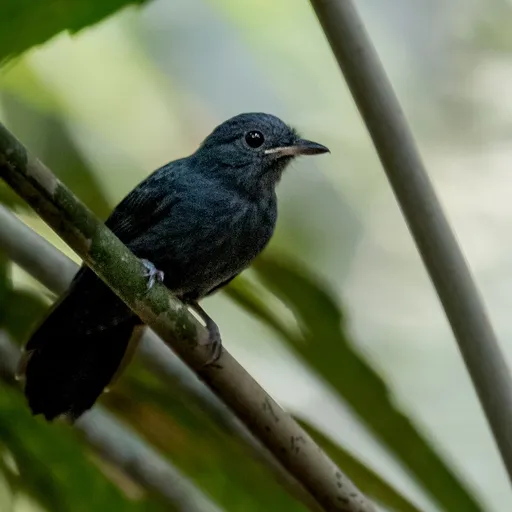
Cinereous Antshrike
Thamnomanes caesius
Least Concern
Listen
XC249048 · Niels Krabbe · Orellana: 'Maxus' road km 37 (27 km SSE Pompeya), Ecuador · CC BY-SA 4.0
Overview
The cinereous antshrike (Thamnomanes caesius) is an insectivorous bird belonging to the subfamily Thamnophilinae of the family Thamnophilidae, commonly known as the typical antbirds. It is a year-round resident found across a wide but disjunct range throughout South America, currently classified as Least Concern by the IUCN.
Identification
- Adults of the nominate subspecies are almost entirely dark gray in males, with white inner edges on the secondaries and underwing coverts; females feature olive-brown upperparts with a small white patch between the scapulars.
- Measures between 14 and 15 cm in length and weighs 16 to 18 g.
- The song consists of a series starting with slow, sharply rising notes that descend into a short rattle, often described as "whee? whee? whee? whee-whee-whee-wheep-wheep-whip-whipwhip-p-p-p-p-p-p-prrrrr".
- Distinct calls include a staccato 'wer-chicory' and 'wu-chidididik'.
Habitat
The species inhabits the understorey to mid-storey of terra firme, várzea, and igapó evergreen forests, rarely occurring in secondary growth. It has a disjunct distribution across Bolivia, Brazil, Colombia, Ecuador, French Guiana, Guyana, Peru, Suriname, and Venezuela, typically occurring below 600 m, though reaching 1,100 m on Venezuelan tepuis.
Diet
Its diet consists primarily of insects and other arthropods. It forages from near the ground up to 20 m, typically capturing prey with a sally from a perch to catch it in mid-air, and occasionally attends army ant swarms.
Did you know?
The specific epithet caesius is the Latin for 'bluish gray', referencing the plumage of the nominate subspecies. Males of the T. c. glaucus subspecies are notably distinct, possessing a whitish throat and a large white intrascapular patch.
Sources
- Wikipedia · CC BY-SA 4.0
- Wikidata · CC0 1.0