
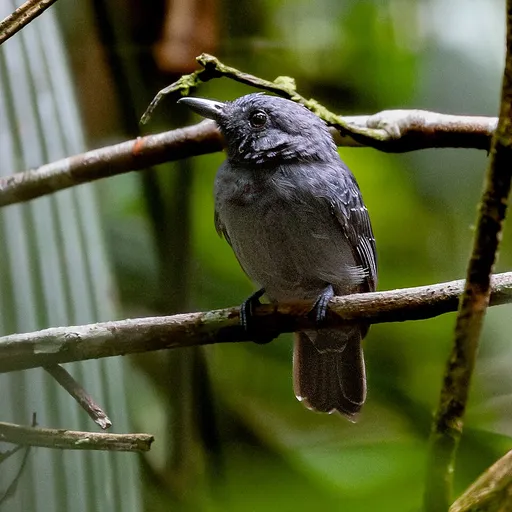
Saturnine Antshrike
Thamnomanes saturninus
Least Concern
Overview
The saturnine antshrike (Thamnomanes saturninus) is a species of bird in the family Thamnophilidae, commonly known as the typical antbirds. It is native to the Amazonian regions of Bolivia, Brazil, and Peru, where it inhabits the understorey of evergreen forests. The species is currently classified as Least Concern by the IUCN due to its large range and stable population.
Identification
- Length ranges from 13.5 to 14.5 cm with a weight of 19 to 21 g.
- Adult males possess darkish grey upperparts with a white patch between the scapulars, while females feature olive-brown upperparts and rufous wings.
- The song is described as an accelerated, ascending series of notes that begins grating before becoming sharp and piercing, accompanied by calls such as a short 'chirr' or a downslurred rasp.
Habitat
This species primarily inhabits the understorey of terra firme evergreen forest and less frequently várzea forest, typically occurring below 300 m in elevation though reaching 650 m in Bolivia. Its distribution is split between the western subspecies found in northeastern Peru and southwestern Brazil, and the nominate subspecies occupying south-central Amazonian Brazil and northeastern Bolivia.
Diet
The diet consists of insects and likely other arthropods, foraged between 1 and 4 m above the ground. The bird usually captures prey by sallying from a perch to foliage, stems, or trunks, and often joins mixed-species feeding flocks or attends army ant swarms.
Did you know?
Although the species is a year-round resident, very little is known about its breeding biology beyond the fact that the season includes August. One recorded nest was constructed as a cup attached between two limbs of a sapling approximately 3 m above the ground.
Sources
- Wikipedia · CC BY-SA 4.0
- Wikidata · CC0 1.0