
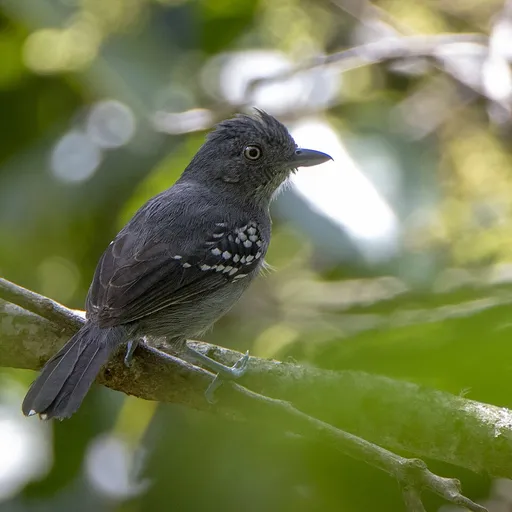
Upland Antshrike
Thamnophilus aroyae
Least Concern
Overview
The upland antshrike (Thamnophilus aroyae) is a species of bird in the subfamily Thamnophilinae of the antbird family. It is found in the eastern Andes of Bolivia and southeastern Peru, where it is considered a year-round resident throughout its range.
Identification
- Adults exhibit significant sexual dimorphism, with males having medium gray upperparts, blacker crowns, and black wings with white-tipped coverts, while females have dark rufous crowns, gray faces with white streaks, and dark olive-brown upperparts.
- The bird measures 14.5 to 15 cm in length and weighs approximately 20 g, featuring a stout, hooked bill similar to that of true shrikes.
- Both sexes possess a highly variable iris color ranging from buffy white to brown, a black maxilla with a paler mandible, and gray or blue-gray legs and feet.
- The song is described as a fast-paced, accelerating series of nasal notes ending in a downslurred terminal note, transcribed as "wur wur-wur-wur-wur'rrrr", accompanied by calls including high whines and a descending caw.
Habitat
The species inhabits the edges of humid montane forest, favoring dense shrubby areas and vine tangles while rarely penetrating the forest interior. It also occurs in newer regrowth in landslide scars and along roads. Its elevational range is between 800 and 1,000 m in Peru and up to 1,700 m in Bolivia, with some sources suggesting a wider range of 600 to 1,900 m in Bolivia.
Diet
The upland antshrike's diet consists mostly of insects, though it is not known in detail. It usually forages singly or in pairs between 1.5 and 3 m above the ground, gleaning prey from leaves, stems, vines, and branches while perched or with short upward sallies, and searching in clusters of dead leaves caught in vine tangles.
Did you know?
The bird may benefit from habitat disturbance in the short term, as it can colonise newly created young second growth and edge habitats, although it remains vulnerable to larger-scale modifications such as the conversion of forests to agriculture.
Sources
- Wikipedia · CC BY-SA 4.0
- Wikidata · CC0 1.0