
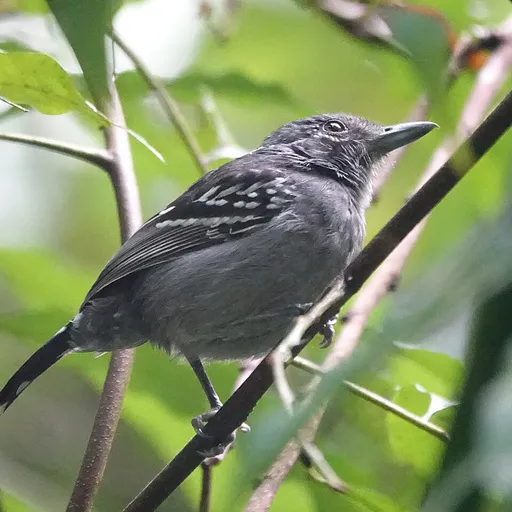
Black-crowned Antshrike
Thamnophilus atrinucha
Least Concern
Listen
XC759722 · radrat · Pipeline Road, Colón, Colón Province, Panama · CC0 1.0
Overview
The black-crowned antshrike (Thamnophilus atrinucha) is a species of bird in the family Thamnophilidae, commonly known as the typical antbirds. It was formerly considered a subspecies of the slaty antshrike but is now recognised as a distinct species with two subspecies.
Identification
- 14 to 15 cm in length, with a stout, hooked bill resembling that of a shrike.
- Significant sexual dimorphism: adult males have slaty grey upperparts with a black crown, while females have brown to buffy-brown upperparts.
- Both sexes possess medium to dark grey legs and feet, with brownish-red to chocolate-brown irises.
- The most common song is described as a series of 'uh' notes ending with a single 'erk' at a higher pitch.
Habitat
Found in every Central American country except El Salvador, and in Colombia, Ecuador, Peru, and Venezuela, the species inhabits a variety of forested landscapes including primary and secondary semi-deciduous and evergreen forests. It favours the forest interior and the understorey to mid-storey layers, though it occurs across all canopy levels, ranging in elevation from sea level up to 1,500 m.
Diet
This species feeds on a wide variety of insects and other arthropods, occasionally capturing small lizards. It forages methodically by gleaning prey from perches, making short upward sallies, hovering, chasing in mid-air, and flipping over leaves on the ground, often joining mixed-species feeding flocks.
Did you know?
Although generally resilient, the black-crowned antshrike's reluctance to cross non-forest matrix habitats may increase its vulnerability to habitat loss.
Sources
- Wikipedia · CC BY-SA 4.0
- Wikidata · CC0 1.0